


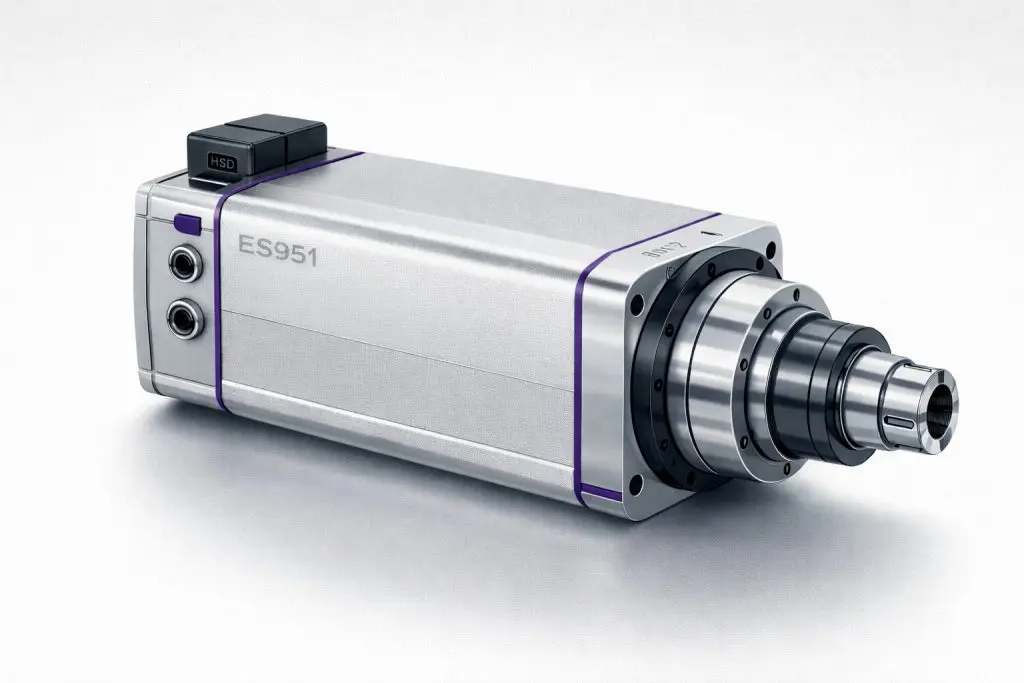
HSD ES951 Spindle Repair & Rebuild Services
Overview
The HSD ES951 is one of the most widely deployed high-power electrospindles in composite, wood, aluminum, and plastic machining environments. It is available in multiple power configurations ranging from 8 kW up to 30 kW (S6), with maximum speeds of 24,000 RPM or 36,000 RPM depending on taper and configuration HSD_Cat_Composite_mar24_Web_ENG….
This model is commonly installed in high-production CNC routers and machining centers where continuous duty cycles, heavy cutting loads, and automatic tool changing are required.
Technical Specifications (Official Model Data)
From HSD catalog pages 16–17 HSD_Cat_Composite_mar24_Web_ENG…:
- Body Diameter: Ø142 x 145 mm
- Max Speed: 24,000 RPM / 36,000 RPM (varies by taper)
- Motor Technology: Asynchronous
- Power S1/S6 (40%):
- 8 / 9.6 kW
- 8.5 / 10.2 kW
- 11 / 13.2 kW
- 16 / 19.2 kW
- 25 / 30 kW
- 6.5 / 7.8 kW (36k version)
- Taper Options: ISO30 / HSK F63 / HSK E63 / HSK F50
- Cooling Options: Electric fan / Forced air / Liquid
- Aggregate Anti-Rotation Flange: Yes
- Optional Features:
- Air tool
- Vibration sensor
- Thermal sensor on front bearings
- Wi-Fi connection & myHSD
Application Compatibility
The ES951 is compatible with:
- AG Line aggregates
- AxC Line (C-Axis units)
- Aggregate heads
- Automatic tool change systems HSD_Cat_Composite_mar24_Web_ENG…
It is frequently integrated into 3-axis and 5-axis machining centers used in composite and wood manufacturing environments.
🔍 Common Failure Modes – HSD ES951
Because this spindle is often used in high S6 duty applications (up to 30 kW), it experiences stress patterns that smaller ES units do not.
1️⃣ Front Bearing Failure
- Caused by contamination or improper tooling balance
- More common in 25–30 kW configurations
- Early signs: high-frequency vibration, tool chatter
2️⃣ Cooling System Degradation
Liquid-cooled units:
- Internal restriction
- Flow sensor failure
- Stator heat stress
Fan-cooled units:
- Dust loading
- Reduced airflow
- Rear bearing overheating
3️⃣ Tool Clamp Fatigue
High-torque operations accelerate:
- Belleville washer fatigue
- Drawbar wear
- Pull stud deformation
4️⃣ Sensor-Related Faults
Units equipped with:
- Vibration sensors
- Thermal sensors
- Wi-Fi / myHSD monitoring
Can produce intermittent fault codes before mechanical failure occurs.
🔧 ES951 Rebuild Process
Every ES951 rebuild should include:
- Complete disassembly and shaft inspection
- Bearing stack replacement (matched high-speed angular contact set)
- Preload verification
- Drawbar inspection or rebuild
- Cooling system pressure testing
- Rotor balance verification
- Final dynamic balancing
- Thermal growth run test
💰 Repair vs Replace – ES951
Replacement ES951 units (especially 25–30 kW models) represent significant capital cost.
In most cases:
- Stator windings remain salvageable
- Shaft journal damage is minimal
- Failure isolated to bearing stack and drawbar system
Rebuilding typically restores full performance at a fraction of replacement cost, while reducing machine downtime compared to OEM lead times.
🧠 Preventative Maintenance Tips
For ES951 operators:
- Monitor vibration trends monthly
- Keep pull studs within tolerance
- Maintain proper cooling flow rate
- Avoid unbalanced aggregate tooling
- Replace worn tool holders before they damage taper
FAQ Section
How long does ES951 repair take?
Turnaround depends on damage level but typically faster than OEM replacement timelines.
Can a seized ES951 be repaired?
Yes, unless shaft or stator damage is catastrophic.
Do you replace ceramic bearings?
Yes. Bearing selection depends on RPM configuration.
What causes overheating in ES951 units?
Cooling restriction, fan contamination, or overloaded duty cycle.