

If you’re researching HSD ES915 spindle repair, you’re likely dealing with performance issues that appear only under demanding conditions. The spindle may run smoothly at lower speeds, yet begin to vibrate, lose finish quality, or generate excess heat when operated near its upper RPM range.
This page focuses on that specific behavior—because ES915 issues are often tied to thermal stability, not sudden mechanical failure.

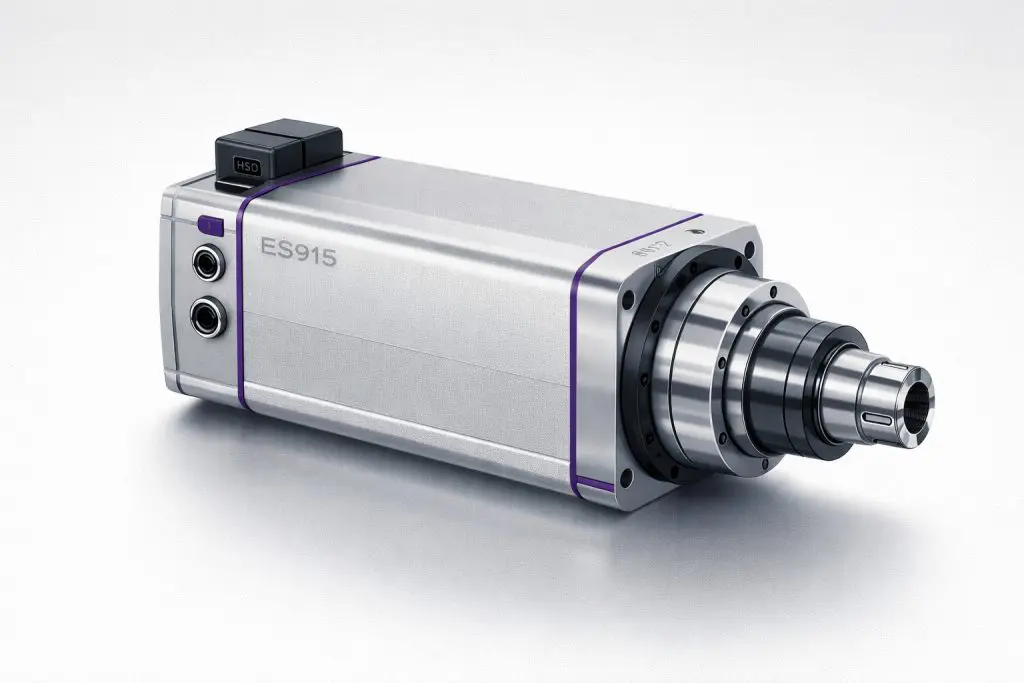
The ES915 is frequently selected for:
- Dust-heavy woodworking and composite environments
- High-speed routing and finishing
- Long production shifts
- Applications where productivity depends on sustained RPM
How the HSD ES915 Is Commonly Used
The ES915 is frequently selected for:
- High-speed routing and finishing
- Long production shifts
- Applications where productivity depends on sustained RPM
- Dust-heavy woodworking and composite environments
These conditions place continuous thermal stress on the spindle’s bearing system.
Early Symptoms ES915 Users Notice
Heat buildup during extended operation
Common reports include:
- Spindle nose noticeably hotter late in the shift
- Heat increasing disproportionately at higher RPM
- Performance improving temporarily when speed is reduced
Vibration that appears only at high speed
Unlike constant vibration failures:
- Low-speed operation feels stable
- Instability increases as RPM rises
- Finish quality degrades primarily during high-speed passes
What’s Typically Happening Inside the ES915
Thermal preload shift in the bearing system
As heat builds:
- Bearing preload changes
- Friction increases
- Micro-vibration develops
This cycle accelerates wear even if the spindle continues to “run.”
Why ES915 Issues Are Often Misdiagnosed
Most users first assume:
- Feeds and speeds need adjustment
- Material quality is inconsistent
- Cooling airflow is insufficient
While operating parameters matter, repeated heat-related symptoms often point to internal bearing instability rather than programming alone.
Repair Options for ES915 Spindles
Evaluation focused on heat and vibration
A targeted evaluation can:
- Measure vibration trends across RPM ranges
- Identify thermal instability early
- Confirm whether rebuild is necessary
Bearing rebuild when thermal wear is confirmed
When preload loss or bearing wear is present:
- Rebuilding restores thermal stability
- Heat generation decreases
- High-RPM performance becomes consistent again
Why Continuing to Run Gets Expensive
Running through heat-related symptoms can:
- Accelerate bearing damage
- Increase internal friction
- Turn a manageable rebuild into a more extensive repair
Heat is one of the fastest ways to shorten spindle life.
Manufacturer-Recommended Maintenance for the HSD ES915
According to HSD’s official electrospindle documentation for the ES9XX series, proper maintenance is essential to maintaining thermal stability and bearing life.
Manufacturer guidance generally emphasizes:
- Keeping the spindle taper and tool interface clean and free of debris
- Monitoring operating temperatures during extended high-speed use
- Maintaining clean airflow and unobstructed cooling paths
- Avoiding unnecessary lubrication, as bearings are factory-lubricated for life
- Performing routine visual and functional checks before extended operation
These recommendations align closely with field experience—most ES915 failures we see are linked to heat buildup combined with long duty cycles.
👉 Reference:
HSD ES9XX Series Spindle Manual (PDF)
https://www.manualslib.com/manual/1532502/Hsd-Es915.html
Preventative Practices That Help ES915 Spindles Last Longer
To reduce repeat failures:
- Track spindle temperature trends over time
- Allow adequate airflow and cooling during long runs
- Avoid operating continuously in RPM ranges that generate excessive heat
Early awareness makes a measurable difference.
If your ES915 shows rising temperatures or instability at high RPM, an early evaluation can help determine whether internal wear is developing before more extensive damage occurs.
Illustration Disclaimer
Illustrations are representative and used for educational purposes; actual spindle configurations may vary.