

If you’re researching HSD ES951 spindle repair, you’re often dealing with a pattern that’s hard to pin down. The spindle may run acceptably during cutting, but alarms, hesitation, or instability appear after tool changes—especially during acceleration back to speed.
This behavior is common with ES951 spindles and is frequently linked to bearing wear aggravated by ATC cycles, not just electrical or ATC system faults.

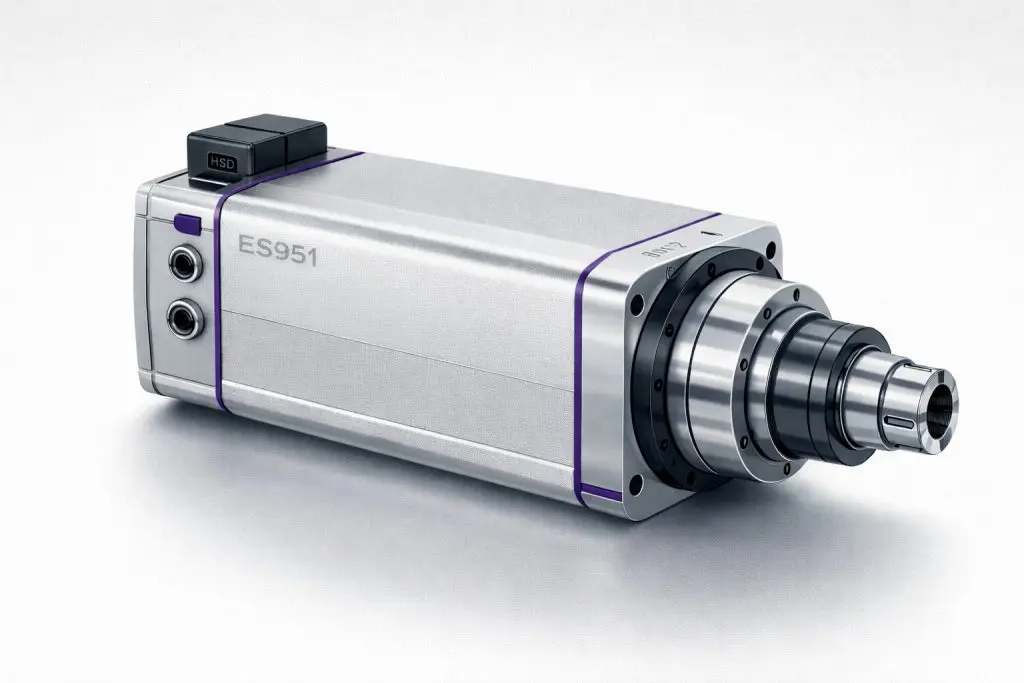
The ES951 is commonly installed on:
- High-production CNC routers
- Nested-based manufacturing systems
- Machines with frequent automatic tool changes
- Applications where cycle time depends on fast tool-to-tool transitions
These conditions place repeated axial and radial stress on the spindle’s internal components.
How the HSD ES951 Is Commonly Used
The ES951 is commonly installed on:
- High-production CNC routers
- Nested-based manufacturing systems
- Machines with frequent automatic tool changes
- Applications where cycle time depends on fast tool-to-tool transitions
These conditions place repeated axial and radial stress on the spindle’s internal components.
Early Symptoms ES951 Users Notice
Issues that follow tool changes
Typical reports include:
- Alarms or faults immediately after tool change
- Inconsistent ramp-up behavior
- Performance improving temporarily after resets
Lack of constant vibration
Early on:
- Cutting performance may seem normal
- Noise may be minimal
- Symptoms appear only during transitions
This makes diagnosis especially challenging.
What’s Typically Happening Inside the ES951
Bearing wear amplified by ATC stress
As bearings wear:
- Tool-change shock loads have greater impact
- Motor feedback becomes unstable
- Control systems interpret instability as electrical faults
Over time, these symptoms become more frequent and harder to ignore.
Why ES951 Issues Are Often Misdiagnosed
Most users first suspect:
- ATC alignment or mechanics
- Sensors or encoders
- Electrical supply or drives
While these systems matter, replacing them without evaluating the spindle often fails to resolve the root cause.
Repair Options for ES951 Spindles
Evaluation focused on tool-change behavior
A targeted evaluation can:
- Correlate instability with ATC cycles
- Identify bearing-related wear
- Avoid unnecessary component replacement
Bearing rebuild when wear is confirmed
When bearing degradation is present:
- Rebuilding stabilizes post-tool-change behavior
- Alarms and hesitation are reduced or eliminated
- Overall reliability improves
Why Ignoring ATC-Related Symptoms Gets Expensive
Continuing to operate with post-tool-change instability:
- Accelerates bearing damage
- Increases risk of secondary component wear
- Turns a manageable repair into a larger rebuild
Early diagnosis protects both spindle and machine.
Manufacturer-Recommended Maintenance for the HSD ES951
HSD’s electrospindle documentation for the ES9XX series outlines maintenance practices that support spindle stability under frequent tool changes.
Manufacturer guidance generally includes:
- Keeping the spindle taper and tool interface clean
- Ensuring proper tool seating and interface condition
- Monitoring spindle behavior during startup and speed changes
- Maintaining clean airflow and cooling
- Avoiding unnecessary lubrication, as bearings are factory-lubricated for life
These recommendations align closely with field experience—ATC-related issues often worsen when early spindle instability is ignored.
👉 Reference:
HSD ES9XX Series Spindle Manual (PDF)
https://www.manualslib.com/manual/1532502/Hsd-Es915.html
Preventative Practices That Help ES951 Spindles Last Longer
To reduce repeat failures:
- Pay attention to behavior immediately after tool changes
- Keep tapers, holders, and interfaces clean
- Investigate intermittent alarms early instead of resetting
ATC stress magnifies small internal issues quickly.
If your ES951 shows instability or alarms after tool changes, an early spindle evaluation can help determine whether internal wear is developing before more extensive damage occurs.
Illustration Disclaimer
Illustrations are representative and used for educational purposes; actual spindle configurations may vary.