
SKF spindle overheating
Overheating in an SKF-equipped spindle is never random. Whether your spindle uses 719xx high-speed hybrid ceramic bearings or 70xx steel super-precision sets, heat rise is typically the first sign of preload imbalance, lubrication breakdown, contamination, or internal friction.
In high-RPM VMC and grinding applications, small changes in preload or lubrication can amplify rapidly.
Atlanta Precision Spindles services the spindle assembly only, focusing on restoring preload integrity, balance, and stable thermal behavior.
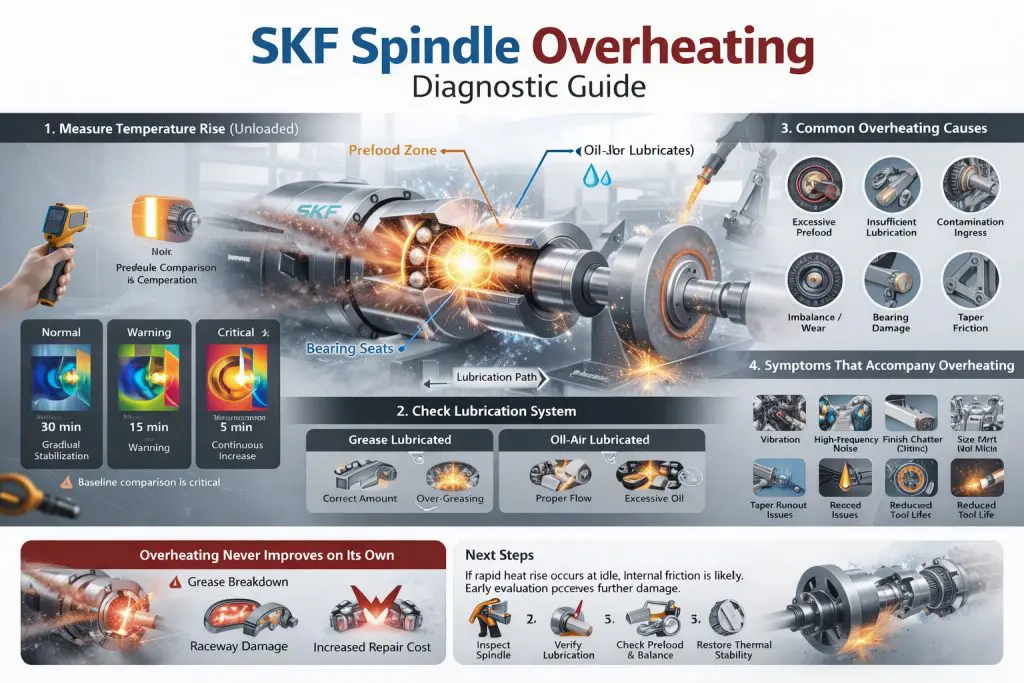
What Temperature Is Too Hot?
Typical operating characteristics:
- Warm and stable under load → Normal
- Gradual temperature rise then stabilizes → Normal behavior
- Rapid heat rise at idle → Warning sign
- Continues increasing without stabilizing → Internal friction issue
The most important indicator is change from baseline.
If the spindle now runs hotter than it did under identical cutting conditions, something has shifted internally.
Common Causes of SKF Spindle Overheating
1️⃣ Preload Imbalance
Too much preload:
- Excess friction
- Rapid heat buildup
- Grease breakdown
Too little preload:
- Micro-skidding
- Surface distress
- Secondary heat rise
Hybrid ceramic systems (719xx HC variants) are especially sensitive to preload error.
2️⃣ Lubrication Problems
Over-greasing:
- Churning drag
- Elevated operating temperature
Incorrect grease type:
- Poor film strength at speed
- Heat instability
Oil-air systems:
- Too much oil → heat
- Too little oil → surface distress
Lubrication errors are one of the most common overheating causes.
3️⃣ Contamination Ingress
Coolant mist, fine chips, or grinding dust can:
- Degrade lubricant
- Increase friction
- Pit raceways
- Accelerate heat rise
Grinding spindles are particularly vulnerable to abrasive contamination.
4️⃣ Rotor Imbalance
As bearings degrade:
- Balance shifts
- Vibration increases
- Heat rises with RPM
Heat + vibration often occur together.
5️⃣ Taper or Tool Interface Issues
In VMC spindles (CAT40 / ISO30):
- Tool seating issues
- Taper fretting
- Pull-stud inconsistency
These can increase friction load and elevate operating temperature.
Hybrid Ceramic vs Steel: Heat Differences
Hybrid 719xx bearings:
- Lower friction at speed
- Higher RPM capability
- More sensitive to preload and lubrication
Steel 70xx bearings:
- Slightly higher friction
- More tolerant of load
- Still sensitive to incorrect assembly
If a hybrid spindle suddenly runs hotter than normal, preload or lubrication drift is often involved.
Symptoms That Accompany Overheating
- Vibration increasing with RPM
- High-frequency bearing whine
- Finish chatter
- Dimensional drift in grinding
- Measurable taper runout
- Reduced tool life
Overheating rarely occurs alone — it usually appears with performance degradation.
Quick Diagnostic Checklist
Before removing the spindle:
✔ Run unloaded at multiple RPM ranges
✔ Measure temperature rise over time
✔ Check lubrication system (if oil-air)
✔ Inspect tooling and holders
✔ Compare to previous baseline temperature
If temperature rises rapidly at idle, internal spindle friction is likely.
What Happens If You Keep Running It Hot?
- Grease breakdown accelerates
- Bearing surfaces pit
- Preload changes
- Rotor balance shifts
- Shaft damage risk increases
Early evaluation often limits repair to bearings and seals.
Delayed repair increases rebuild cost significantly.
Our Approach to Overheating SKF Spindles
When servicing overheating spindles, we focus on:
- Bearing designation verification
- Preload class confirmation
- Controlled assembly procedures
- Lubrication evaluation
- Dynamic balance correction
- Runout verification
- Thermal stabilization testing
The goal is stable operating temperature at target RPM.
Atlanta Precision Spindles repairs the spindle assembly only — not the CNC or grinding machine.
Restore Thermal Stability
If your SKF-based spindle is running hotter than normal, early evaluation can prevent internal damage and reduce downtime.
Contact Atlanta Precision Spindles to discuss your spindle configuration and operating symptoms.