
How Vibration Accelerates CNC Spindle Bearing Failure
Understanding the Hidden Damage Inside the Spindle
Vibration is one of the most destructive forces inside a CNC spindle. While contamination often starts the failure process, vibration rapidly accelerates bearing wear and shortens spindle life. Even small increases in vibration can multiply internal stress, leading to heat buildup, lubrication failure, and premature bearing damage.
This page explains how vibration progresses inside a CNC spindle and why early correction is critical.
Stage 1: Imbalance and Preload Changes
Vibration often begins with subtle issues such as:
- Bearing wear
- Minor imbalance
- Improper preload
- Tooling or taper issues
At this stage, vibration levels may still fall below alarm thresholds. However, even low-level vibration places uneven loads on spindle bearings.
Key impact: Bearings no longer distribute load evenly, increasing localized stress.
Stage 2: Heat Generation and Lubrication Breakdown
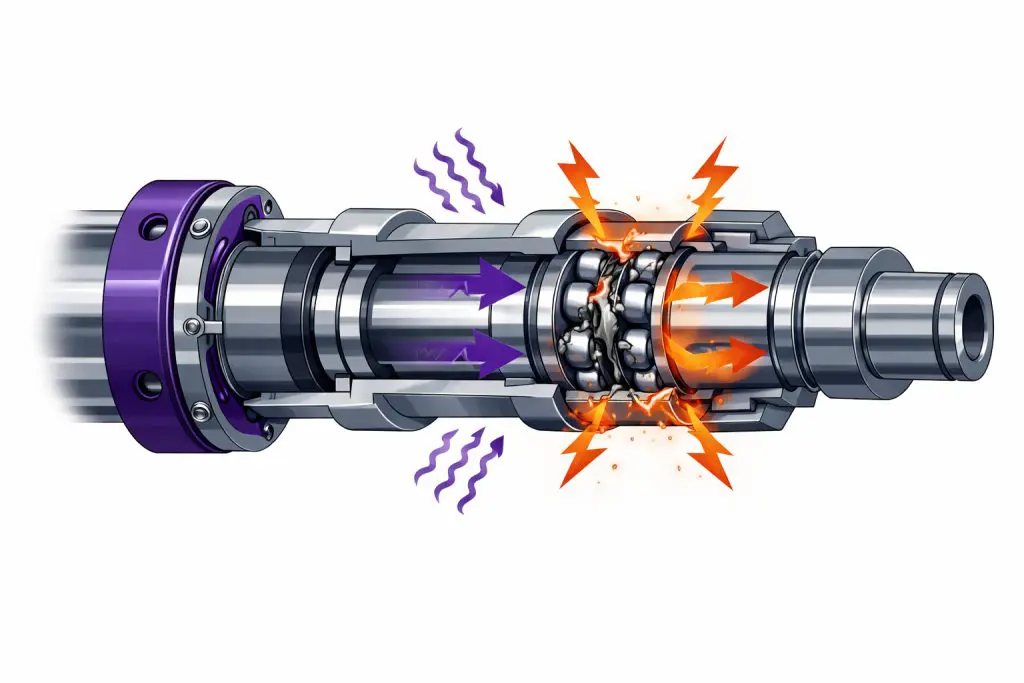
Consequences include:
- Accelerated wear of raceways and rolling elements
- Grease thinning or breakdown
- Loss of bearing preload stability
- Accelerated wear of raceways and rolling elements
As vibration increases, friction inside the bearing set rises. This friction generates excess heat, which directly affects lubrication.
Once lubrication degrades, bearing damage accelerates quickly.
Stage 3: Surface Fatigue and Micro-Damage
Sustained vibration causes microscopic surface damage inside the bearing:
- Pitting and spalling
- Raceway surface fatigue
- Rolling element deformation
These defects create additional vibration, forming a self-reinforcing failure cycle.
Vibration causes damage — damage creates more vibration.
Stage 4: Cutting Performance Degradation
As internal damage progresses, vibration becomes noticeable at the cutting tool.
Common machining symptoms include:
- Chatter during finishing passes
- Poor surface finish
- Reduced tool life
- Difficulty holding tight tolerances
At this point, production quality suffers and scrap rates increase.
Stage 5: Bearing Failure and Spindle Shutdown
Eventually, bearing preload collapses and vibration spikes beyond safe limits. The spindle may overheat or trigger alarms, forcing an unplanned shutdown.
If left unaddressed, vibration-related failure can lead to:
- Shaft and housing damage
- Longer repair times
- Higher overall repair costs
Early vibration analysis and repair can prevent catastrophic failure.
How Atlanta Precision Spindles Controls Vibration During Repair
At Atlanta Precision Spindles, vibration control is central to every spindle repair.
Our process includes:
- Precision bearing preload setup
- Dynamic balancing at operating RPM
- Inspection and restoration of journals and tapers
- Clean-room assembly to prevent imbalance from contamination
- Final vibration and thermal verification
By addressing vibration at its source, we restore spindle stability and long-term reliability.
When to Take Action
If your CNC spindle shows early signs of vibration, heat, or surface finish issues, internal damage may already be progressing.
Early spindle repair reduces downtime, lowers cost, and protects machining accuracy.