
Weiss RS Series Spindle Repair
Spindle Performance Issues in Robotic Machining Applications
Weiss RS-series spindles are designed specifically for robot-mounted machining applications, where weight, dynamic loads, and continuous multi-axis movement place very different demands on the spindle compared to traditional CNC machines.
When performance issues appear, RS-series spindles rarely fail catastrophically. Instead, users notice gradual changes in cut quality, stability, or repeatability, often amplified by the robot’s motion rather than obvious spindle noise or vibration.
This page provides an overview of common Weiss RS-series spindle issues in robotic applications, helping identify when the spindle—not the robot or program—is the underlying contributor.
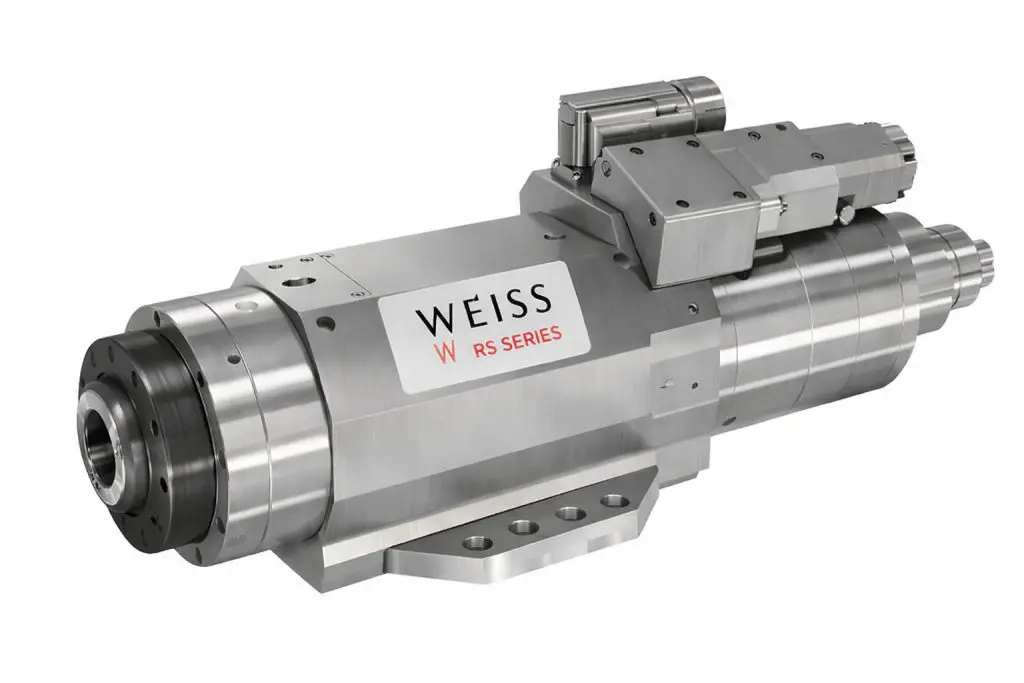
What the Weiss RS Series Is Designed For
The RS series is typically used in:
- Robotic milling and trimming
- Composite machining (carbon fiber, fiberglass)
- Aluminum routing and finishing
- Deburring and edge finishing
- Multi-axis robotic cells
Key design priorities include:
- Low mass for robotic payload limits
- High dynamic balance for moving axes
- Stable operation across wide speed ranges
- Compact form factors for robot integration
Because the spindle is constantly accelerating, decelerating, and changing orientation, internal spindle condition plays a larger role in cut consistency than many users expect.
Common Weiss RS-Series Symptoms in Robotic Cells
Inconsistent cut quality across paths
Users often report:
- Acceptable finish in some orientations
- Tear-out, chatter, or edge inconsistency in others
- Variation tied to robot posture rather than toolpath
This often points to internal spindle stiffness or bearing condition, not just robot rigidity.
Vibration amplified by robot motion
Unlike fixed machines:
- Small spindle imbalance is magnified by robot arms
- Vibration may appear only during motion
- Idle spindle tests may show nothing abnormal
As bearings wear, dynamic imbalance becomes more noticeable in robotic environments.
Accuracy or repeatability drift over time
In longer robotic cycles:
- Path accuracy degrades subtly
- Edge trimming results vary more than expected
- Compensation becomes increasingly common
These symptoms can reflect bearing preload changes or thermal behavior inside the spindle.
Narrowing stable process window
As internal wear progresses:
- Fewer speed and feed combinations remain usable
- Operators slow programs to maintain cut quality
- Productivity drops without a clear failure event
This is a common RS-series wear pattern.
Why RS-Series Spindle Issues Are Often Misdiagnosed
In robotic machining cells, problems are frequently blamed on:
- Robot accuracy or calibration
- Toolpath strategy
- End-of-arm tooling or mounting
- Payload or reach limitations
While all of these matter, spindle condition is often overlooked because:
- The spindle still sounds smooth
- No alarms are present
- Issues vary by robot orientation
In reality, robotic applications tend to expose spindle wear earlier, not later.
Repair Considerations for Weiss RS-Series Spindles
Across the RS series, repair decisions typically focus on:
- Bearing condition and preload stability
- Dynamic balance relative to robot motion
- Interface integrity under changing loads
- Thermal behavior during extended robotic cycles
Early evaluation is especially important in robotic cells, where small spindle issues can cascade into large process problems.
Manufacturer Guidance for Weiss RS-Series Spindles
Manufacturer documentation for Weiss robotic spindles generally emphasizes:
- Proper warm-up before production
- Avoiding shock loads during engagement and retraction
- Maintaining clean lubrication and cooling
- Monitoring cut quality trends rather than waiting for alarms
- Investigating performance changes early
Users should always consult official Weiss documentation specific to their RS model and robotic application for detailed operating and maintenance guidance.
Final Thought
In robotic machining, the spindle is rarely isolated from the process.
Weiss RS-series spindles typically signal problems through cut inconsistency, vibration during motion, or reduced repeatability, not sudden failure. Recognizing those signals early helps protect both the spindle and the robotic cell.
Illustrations are representative and used for educational purposes; actual spindle configurations may vary.