
Kessler DMS 100 Spindle Repair: Milling Stability Under Sustained Load
The Kessler DMS 100 is engineered for demanding milling applications where rigidity, thermal mass, and load capacity are critical to maintaining accuracy. When internal conditions begin to change, performance rarely drops off suddenly. Instead, users notice gradual shifts—milling accuracy drifting during longer or heavier cutting cycles, finish degrading under sustained load, or a shrinking stable process window—while the spindle itself continues to run smoothly. These patterns often indicate internal bearing or preload changes rather than tooling, programming, or machine issues.
How the Kessler DMS 100 Is Used in Milling Applications
Early Milling-Related Symptoms Seen in DMS 100 Spindles
Accuracy loss during sustained cutting
Users often report:
Parts holding tolerance initially, then drifting during extended milling
- Increased compensation required later in the cycle
- Variation between short and long run results
- Finish degradation under heavy load
Finish degradation under heavy load
As wear progresses:
- Finish breaks down during deeper cuts
- Tool marks become inconsistent
- Reducing load temporarily improves results
These symptoms frequently appear without obvious vibration or noise.
What’s Typically Happening Inside the DMS 100 During Milling
Bearing preload changes under prolonged load
In high-load milling:
- Bearings experience sustained radial and axial forces
- Heat buildup alters preload behavior
- Shaft growth affects tool position and interface stability
Because the DMS 100 is designed for stiffness, even small preload changes can affect milling accuracy when loads are high and continuous.
Why Milling Issues Are Often Misdiagnosed
Initial troubleshooting often focuses on:
- Tool selection and holder condition
- CAM strategies and step-down choices
- Fixturing or workholding rigidity
While these factors matter, recurring accuracy or finish problems that correlate with cut duration and load often trace back to internal spindle condition.
Repair Options for Kessler DMS 100 Milling Spindles
Load- and duration-focused spindle evaluation
A proper evaluation can:
- Assess bearing condition under simulated milling loads
- Correlate thermal behavior with accuracy loss
- Determine whether repair is still economically viable
Precision bearing rebuild and dynamic balancing
When wear is confirmed:
- Bearings are replaced to OEM-level specifications
- Preload and stiffness are restored
- Balance is verified for stable milling across the operating range
The result is predictable accuracy and finish during long, heavy milling cycles.
Repair vs Replacement — Especially Important for DMS 100
Because DMS 100 spindles are often used in high-value production environments, delaying repair can:
- Accelerate bearing and shaft damage
- Increase tooling costs
- Expand repair scope significantly
In many cases, early repair preserves spindle value and avoids unnecessary replacement.
Manufacturer-Recommended Maintenance for Kessler Milling Spindles
According to Kessler documentation and service guidance, maintaining milling performance depends on practices that support bearing life and thermal stability.
Manufacturer guidance generally emphasizes:
- Proper warm-up before heavy milling
- Avoiding extended operation at excessive cutting loads
- Monitoring accuracy and finish trends over time
- Maintaining clean cooling and lubrication systems
- Investigating performance changes early rather than compensating
Users should always consult official Kessler documentation specific to their spindle model and configuration for detailed guidance.
Preventative Practices That Help DMS 100 Spindles Last Longer
To extend service life in milling applications:
- Track accuracy relative to run time and load, not just RPM
- Avoid permanently reducing cutting parameters to mask instability
- Address load-related changes early
In heavy milling, time under load reveals spindle problems faster than speed.
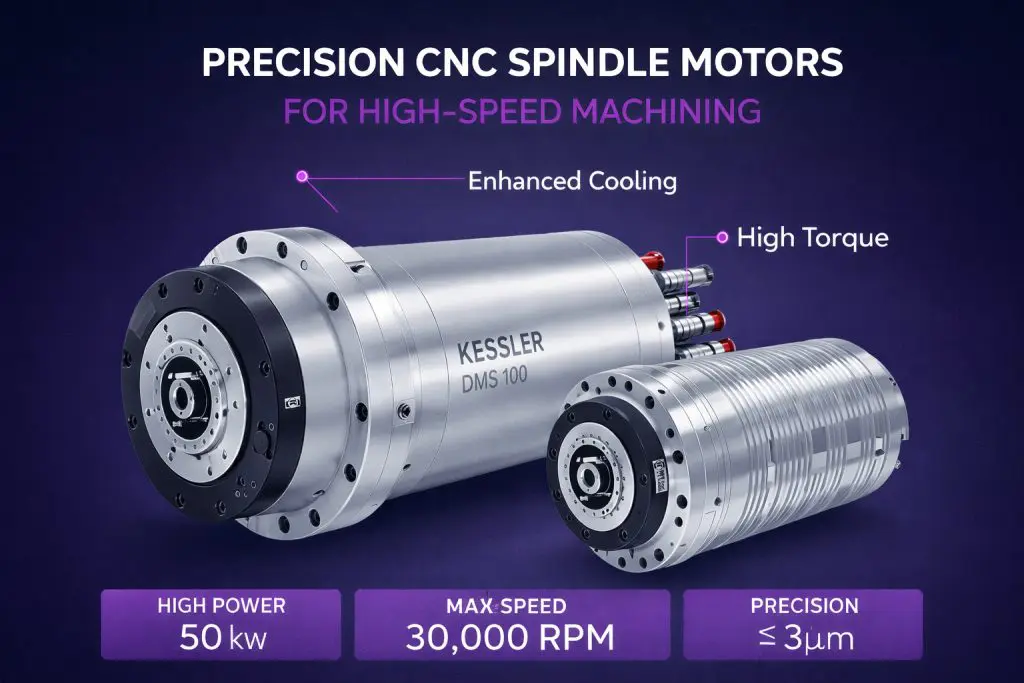
Illustrations are representative and used for educational purposes; actual spindle configurations may vary.