-
Omlat BELT-G Spindles for Grinding
Belt-Driven Grinding Spindles Designed for Torque, Stability, and Finish Control Omlat manufactures specialized spindles for grinding applications where torque stability, smooth rotation, and thermal consistency matter more than extreme RPM. The BELT-G spindle family is a belt-driven design commonly used in cylindrical, internal, and special grinding machines. This page focuses on the BELT-G spindle design…
-
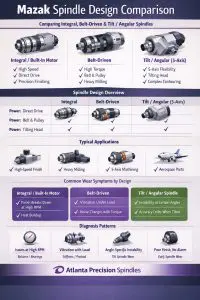
Mazak Spindle Design Comparison
Comparing Integral, Belt-Driven, and Tilt / Angular Spindle Designs Mazak machines use different spindle designs depending on speed, torque, and machining flexibility requirements. While the machine platform may remain mechanically sound for decades, the spindle design determines how wear develops and how symptoms appear. This comparison page helps identify which spindle design is in use,…
-
Tilt / Angular Spindle Repair (5-Axis Mazak)
When Accuracy or Stability Changes With Head Orientation Mazak 5-axis platforms use tilt / angular spindle designs to maintain tool orientation during complex machining. These spindles introduce additional mechanical complexity because the spindle axis pivots, changing load direction and leverage throughout the cut. When issues develop, they rarely appear everywhere at once. Instead, users notice…
-
Belt-Driven Spindle Repair (Mazak)
High-Torque Spindle Performance When Load-Related Vibration or Noise Appears Mazak machines commonly use belt-driven spindle designs in applications where torque, robustness, and load handling are more important than extreme spindle speed. In this architecture, power is transmitted from an external motor to the spindle through belts and pulleys rather than an integrated motor. When performance…
-
Integral / Built-In Motor Spindle Repair (Mazak)
High-Speed Performance When Finish, Heat, or Stability Starts to Change Mazak machines commonly use integral (built-in motor) spindle designs in applications that demand rapid acceleration, smooth rotation, and high-speed finishing. In these designs, the motor is integrated directly into the spindle housing, eliminating belts and transmission components. When performance issues develop, they rarely appear as…
-
Mazak Spindle Design Classifications
Understanding Mazak Spindle Types by Design, Application, and Symptoms Mazak machines are known for rigidity, control technology, and long service life. When machining performance changes over time, the root cause is often not the machine itself, but the spindle design used within the machine. Mazak uses several distinct spindle architectures depending on application demands. Each…
-
Fischer Micromilling Spindle Preventative Maintenance
Protecting Tool Life, Finish Quality, and Micron-Level Accuracy Fischer micromilling spindles operate at the edge of what machining systems can tolerate. Tool diameters are small, tolerances are measured in microns, and spindle speeds amplify even the slightest imbalance or runout. In this environment, spindle problems rarely appear as loud failures or obvious alarms. Instead, they…
-
Fischer HSK-A Micromilling Spindle Repair
When Accuracy Drifts During Long Runs or Finishing Cycles Fischer HSK-A micromilling spindles are commonly selected for precision finishing and micro-feature machining where a balance of stiffness, accuracy, and high rotational speed is required. Unlike ultra-light HSK-E applications, HSK-A spindles are often used in longer machining cycles and slightly broader process windows. When issues develop,…
-
Fischer HSK-E Micromilling Spindle Repair
When Micro-Tool Life and Finish Degrade Without Obvious Vibration Fischer HSK-E micromilling spindles are designed for extreme precision, where tool diameters are small, cutting forces are minimal, and tolerances are unforgiving. In these environments, spindle issues rarely present as noise or obvious vibration. Instead, users notice shortened micro-tool life, subtle finish degradation, or instability at…
-
Fischer HSK Micromilling Spindles
Understanding the Fischer HSK Product Line for Ultra-High-Precision Machining Fischer HSK micromilling spindles are engineered for applications where extreme rotational speed, minimal runout, and thermal stability are non-negotiable. In micromilling environments, even small deviations in spindle behavior can directly affect tool life, surface finish, and dimensional accuracy. This page provides an overview of the Fischer…
For Spindle Repair Call: (678) 225-7855