
HSD ES950 Spindle Repair: Motor Problem or Bearing Failure?
← Back to HSD ES Series Spindle Repair
If you’re researching HSD ES950 spindle repair, you’re often facing a confusing situation. The spindle may trigger alarms, hesitate during ramp-up, or show inconsistent performance — yet vibration and cutting quality don’t always clearly point to a mechanical failure.
This is a common ES950 scenario. Because the motor and spindle are integrated, bearing wear can create symptoms that look electrical, leading to misdiagnosis.
How the HSD ES950 Is Commonly Used
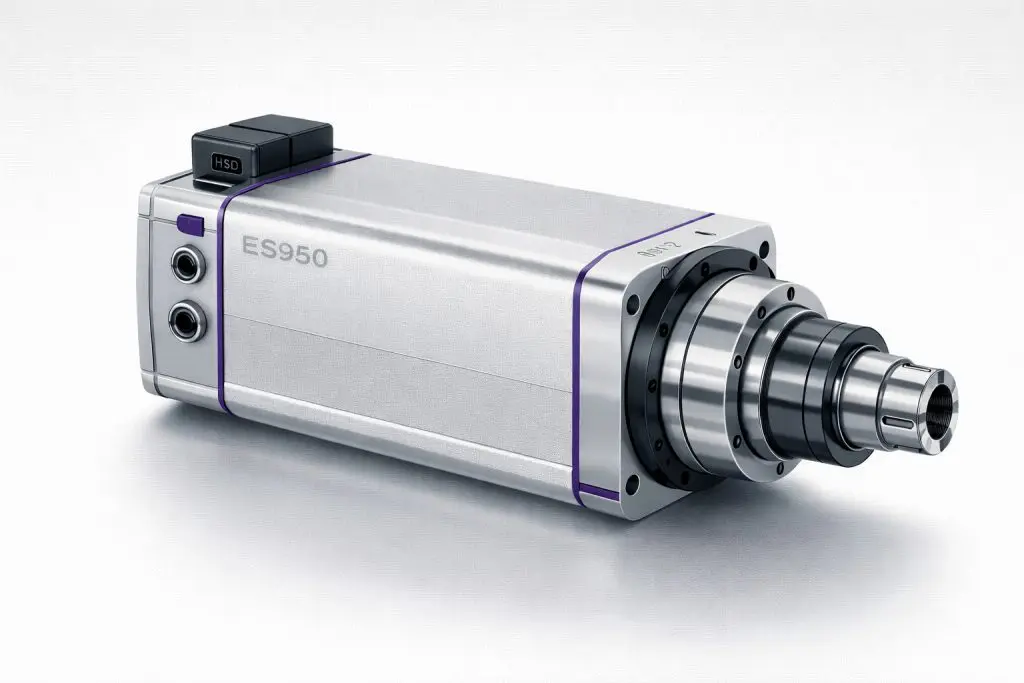
The ES950 is widely used in:
- Production CNC routers
- Mixed-material machining environments
- Applications requiring frequent speed changes
Its motor-integrated design improves performance but also blurs the line between electrical and mechanical symptoms.
Early Symptoms ES950 Users Notice
Alarms or faults without obvious vibration
Users commonly report:
- Drive or spindle alarms during acceleration
- Faults that appear intermittently
- Performance improving briefly after resets
Noise or hesitation during speed changes
Instead of constant chatter:
- Noise changes with RPM
- Hesitation appears during ramp-up
- Load feels inconsistent even without heavy cutting
What’s Typically Happening Inside the ES950
Bearing wear affecting motor feedback
As bearings degrade:
- Motor load increases unevenly
- Feedback signals fluctuate
- Control systems interpret instability as electrical faults
The spindle may still cut, but internal wear continues to progress.
Why ES950 Issues Are Often Misdiagnosed
Most users initially suspect:
- Drives or inverters
- Electrical supply issues
- Sensors or encoders
While these components do fail, replacing them without spindle evaluation often fails to resolve the root problem.
Repair Options for ES950 Spindles
Combined mechanical and electrical evaluation
A focused evaluation can:
- Compare vibration and current draw
- Identify bearing-induced electrical symptoms
- Prevent unnecessary electrical replacements
Bearing rebuild or motor service
When confirmed:
- Bearing rebuild stabilizes motor load
- Electrical faults disappear
- Performance becomes consistent again
Why Replacing Electrical Components First Gets Expensive
Replacing drives or controls:
- Adds cost without fixing the root cause
- Delays proper spindle repair
- Allows internal wear to worsen
Identifying the true source early saves time and money.
Manufacturer-Recommended Maintenance for the HSD ES950
HSD’s electrospindle documentation for the ES9XX series emphasizes maintenance practices that support both mechanical and electrical stability.
Manufacturer guidance generally includes:
- Keeping the spindle taper and tool interface clean
- Ensuring unobstructed airflow and cooling
- Monitoring spindle behavior during startup and speed changes
- Avoiding unnecessary lubrication, as bearings are factory-lubricated for life
- Performing routine functional checks before extended operation
These practices align with field experience—many ES950 failures begin as subtle bearing issues that later appear as electrical faults.
👉 Reference:
HSD ES9XX Series Spindle Manual (PDF)
https://www.manualslib.com/manual/1532502/Hsd-Es915.html
Preventative Practices That Help ES950 Spindles Last Longer
To reduce repeat issues:
- Investigate alarms early instead of resetting
- Track current draw alongside vibration
- Keep cooling systems clean and unrestricted
Motor and bearing health must be considered together.
If your ES950 is throwing alarms or behaving inconsistently, an early spindle evaluation can help determine whether the issue is electrical, mechanical, or both.
Related Pages
- HSD ES950 Spindle Repair & Rebuild Services — full service page
- HSD ES951: When Problems Appear After Tool Changes
- Back to HSD ES Series overview
Ready to send in your ES950? Contact Atlanta Precision Spindles for an evaluation.
Illustration Disclaimer
Illustrations are representative and used for educational purposes; actual spindle configurations may vary.