
Posts by Atlanta Precision Spindles
Spindles for High-Speed Milling
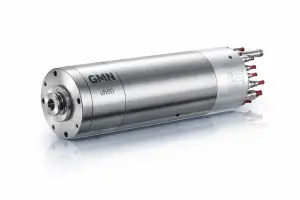
How Speed, Balance, and Thermal Stability Shape Performance—and Failure High-speed milling places very different demands on a spindle than general machining or heavy cutting. In these applications, spindle condition directly affects surface finish, tool life, and dimensional accuracy, often long before alarms or noise appear. This page explains how high-speed milling spindles behave, what early…
Read MoreIs It the Spindle or the Machine?
A Diagnostic Guide for Matsuura CNC Equipment When machining results change on a Matsuura machine, the cause isn’t always where it looks like it is. Surface finish, vibration, heat, and accuracy drift can originate either from the spindle assembly or from machine components (axes, ballscrews, servo systems, control issues) — and the best way to…
Read MoreMatsuura Spindle Preventative Maintenance
Catching Performance Issues Early—Before Downtime or Scrap Matsuura machines are built for long-term accuracy, thermal stability, and continuous production. In many cases, the machine itself remains mechanically sound even as machining results begin to change. That’s because spindle wear develops gradually, especially in high-speed and precision applications. Preventative maintenance for Matsuura spindles focuses on recognizing…
Read MoreOmlat D-Drive Spindles for Steel Milling
Direct-Drive Milling Spindles for Stiffness, Torque Density, and Thermal Control Omlat designs D-Drive (direct-drive) spindles for milling applications where steel cutting, stiffness, and torque consistency are more critical than belt isolation or ultra-high speed. Unlike belt-driven spindles, D-Drive spindles integrate the motor directly into the spindle assembly. This eliminates belts and pulleys, allowing for more…
Read MoreOmlat BELT-M Spindles for Milling
Omlat manufactures the BELT-M spindle family for milling and material-removal applications where torque delivery, mechanical robustness, and process flexibility are more important than extreme rotational speed. Unlike grinding-focused spindle families, BELT-M spindles are designed to handle intermittent cutting loads, changing engagement conditions, and a broader range of tooling while maintaining stable performance. What the BELT-M…
Read MoreOmlat BELT-G Spindles for Grinding
Belt-Driven Grinding Spindles Designed for Torque, Stability, and Finish Control Omlat manufactures specialized spindles for grinding applications where torque stability, smooth rotation, and thermal consistency matter more than extreme RPM. The BELT-G spindle family is a belt-driven design commonly used in cylindrical, internal, and special grinding machines. This page focuses on the BELT-G spindle design…
Read MoreMazak Spindle Design Comparison
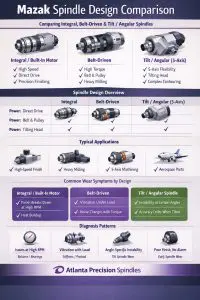
Mazak Spindle Repair Mazak Spindle Design Classifications Mazak uses three distinct spindle architectures — integral, belt-driven, and tilt/angular — and each one fails differently. Understanding the design in your machine is the fastest path to accurate diagnosis and the right repair decision. On This Page Integral / Built-In Belt-Driven Tilt / Angular Symptom Comparison Repair…
Read MoreTilt / Angular Spindle Repair (5-Axis Mazak)
Mazak Spindle Repair Tilt / Angular Spindle Repair (5-Axis Mazak) When accuracy or stability changes with head orientation. Mazak 5-axis platforms use tilt/angular spindle designs to maintain tool orientation during complex machining. These spindles introduce additional mechanical complexity because the spindle axis pivots, changing load direction and leverage throughout the cut. On This Page Design…
Read MoreBelt-Driven Spindle Repair (Mazak)
Mazak Spindle Repair Belt-Driven Spindle Repair (Mazak) High-torque spindle performance when load-related vibration or noise appears. Mazak machines use belt-driven designs where torque, robustness, and load handling matter more than extreme speed. When performance issues develop, they rarely stop production immediately — users notice vibration under load, noise that changes with cutting force, or declining…
Read MoreIntegral / Built-In Motor Spindle Repair (Mazak)
Mazak Spindle Repair Integral / Built-In Motor Spindle Repair (Mazak) High-speed performance when finish, heat, or stability starts to change. Mazak machines commonly use integral spindle designs in applications demanding rapid acceleration, smooth rotation, and high-speed finishing. When performance issues develop, they rarely appear as sudden failures. On This Page Design Overview Warning Signs Internal…
Read More