
Mazak
Mazak Quick Turn & Nexus Series Spindle Repair
High-volume production. Continuous spindle stress. Atlanta Precision Spindles rebuilds turning spindle assemblies for the Mazak Quick Turn and Nexus Series — bearing replacement, preload restoration, and Class 10K clean room assembly across the full QT lineup. The Mazak Quick Turn Series has been in production since 1981 with cumulative worldwide sales approaching 100,000 units. These…
Read MoreMazak Integrex Series Spindle Repair
=== ARTICLE CONTENT (paste via Code Editor) === Multi-tasking machines. Multi-axis spindle wear. Atlanta Precision Spindles rebuilds milling and turning spindle assemblies for the Mazak Integrex i-H Series — bearing replacement, drawbar service, preload restoration, and Class 10K clean room assembly. The Mazak Integrex is a different kind of machine to repair spindles on. Where…
Read MoreMazak VCN Series Spindle Repair
High-speed machining. High-hour bearing wear. Atlanta Precision Spindles rebuilds spindle assemblies for the full Mazak VCN Series — bearing replacement, preload restoration, taper bore inspection, and Class 10K clean room assembly across all VCN platforms. Atlanta Precision Spindles rebuilds spindle assemblies for the full Mazak VCN Series — including the VCN-430, VCN-570, VCN-575, VCN-700, and…
Read MoreMazak Machines That Commonly Require Spindle Repair
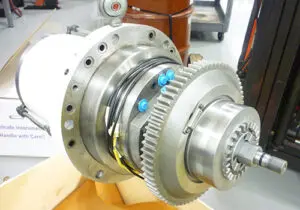
Mazak Spindle Repair Mazak Machines That Commonly Require Spindle Repair Many Mazak machining centers use high-precision spindle assemblies designed for continuous production and high-speed machining. Over time, heavy cutting loads, long operating hours, and environmental contamination lead to bearing wear and spindle damage across all platform types. Machine Platforms VCN Series Integrex Quick Turn Nexus…
Read MoreMazak Spindle Design Comparison
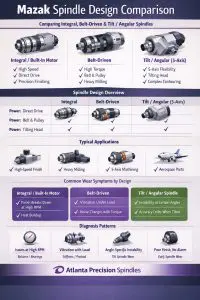
Mazak Spindle Repair Mazak Spindle Design Classifications Mazak uses three distinct spindle architectures — integral, belt-driven, and tilt/angular — and each one fails differently. Understanding the design in your machine is the fastest path to accurate diagnosis and the right repair decision. On This Page Integral / Built-In Belt-Driven Tilt / Angular Symptom Comparison Repair…
Read MoreTilt / Angular Spindle Repair (5-Axis Mazak)
Mazak Spindle Repair Tilt / Angular Spindle Repair (5-Axis Mazak) When accuracy or stability changes with head orientation. Mazak 5-axis platforms use tilt/angular spindle designs to maintain tool orientation during complex machining. These spindles introduce additional mechanical complexity because the spindle axis pivots, changing load direction and leverage throughout the cut. On This Page Design…
Read MoreBelt-Driven Spindle Repair (Mazak)
Mazak Spindle Repair Belt-Driven Spindle Repair (Mazak) High-torque spindle performance when load-related vibration or noise appears. Mazak machines use belt-driven designs where torque, robustness, and load handling matter more than extreme speed. When performance issues develop, they rarely stop production immediately — users notice vibration under load, noise that changes with cutting force, or declining…
Read MoreIntegral / Built-In Motor Spindle Repair (Mazak)
Mazak Spindle Repair Integral / Built-In Motor Spindle Repair (Mazak) High-speed performance when finish, heat, or stability starts to change. Mazak machines commonly use integral spindle designs in applications demanding rapid acceleration, smooth rotation, and high-speed finishing. When performance issues develop, they rarely appear as sudden failures. On This Page Design Overview Warning Signs Internal…
Read MoreMazak Spindle Design Classifications
Understanding Mazak Spindle Types by Design, Application, and Symptoms Mazak machines are known for rigidity, control technology, and long service life. When machining performance changes over time, the root cause is often not the machine itself, but the spindle design used within the machine. Mazak uses several distinct spindle architectures depending on application demands. Each…
Read More