Posts by Atlanta Precision Spindles
Why Your Hardinge Lathe Is Losing Finish Quality
A Practical Diagnostic Guide for Turning Precision Hardinge lathes are built for tight tolerances and smooth finishes. So when surface quality starts to decline — even slightly — it usually means something in the system has changed. If you’re noticing: The cause is rarely random. This guide walks through the most common reasons Hardinge turning…
Read MoreHardinge High-Precision Turning Spindle Repair
Restoring Concentricity, Thermal Stability, and Surface Finish Hardinge turning centers are known for tight tolerances, smooth finishes, and long-term precision. Whether running collet systems or chucking applications, the spindle is the most critical accuracy component in the machine. Over time, even minor bearing degradation can affect: When precision begins to drift, the spindle is often…
Read MoreHardinge Grinding Spindle Rebuild
Restoring Micron-Level Accuracy and Thermal Stability Hardinge grinding platforms — including cylindrical and precision grinding machines — rely on extremely stable spindle assemblies. Whether internal (ID) or external (OD) grinding, the spindle must maintain: When a grinding spindle begins to drift, the symptoms are subtle at first — but the impact on part accuracy can…
Read MoreHardinge Built-In Motor Spindle Repair
Restoring Precision in Integrated Spindle Systems Hardinge machines are known for precision turning, grinding, and milling performance. Many modern Hardinge platforms utilize built-in motor spindles — also called integral motor spindles — where the motor rotor is directly integrated into the spindle shaft. This design eliminates belts and couplings, allowing for: However, when wear develops,…
Read MoreMultiCam 7000 Series Spindle Repair
High-Duty Router Spindle Rebuild for Industrial Production The MultiCam 7000 Series is engineered for high-production routing environments where rigidity, power, and uptime matter. These machines commonly process: Because the 7000 Series often runs higher horsepower electrospindles for sustained cycles, spindle condition directly affects: When performance begins to drift, the spindle is frequently the first component…
Read MoreMultiCam 5000 Series Spindle Repair
Restoring Stability, Finish Quality, and High-RPM Performance The MultiCam 5000 Series is built for industrial CNC routing environments where rigidity, speed, and production volume matter. These machines commonly run high-speed electrospindles designed for continuous-duty cutting in wood, plastics, aluminum, and composite materials. Over time, however, sustained high RPM and contamination exposure can gradually degrade spindle…
Read MoreIs It the Spindle or the Router?
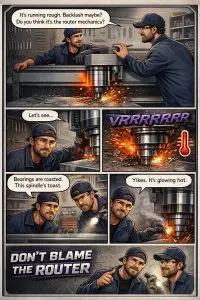
MultiCam Diagnostic Guide for Finish, Vibration, and Accuracy Issues When a MultiCam 3000 Series (or similar router) starts producing poor finish, inconsistent edges, or vibration at higher RPM, the first question most shops ask is: Is the problem the machine… or the spindle? Because the spindle is the highest-speed, most precision component on the router,…
Read MoreMultiCam 3000 Series Spindle Repair
When Finish Quality Drops or Vibration Starts The MultiCam 3000 Series is widely used in CNC routing for wood, plastics, aluminum, and composite materials. Known for its rigidity and production capability, it often runs high-speed electrospindles — most commonly HSD and similar units. Over time, spindle wear can gradually affect: Because routing applications typically run…
Read MoreHybrid Ceramic vs Steel Bearings in CNC Spindles
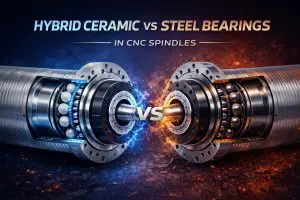
Performance, Heat, Speed, and Longevity Compared CNC spindle performance depends heavily on bearing selection. Two of the most common options are traditional steel bearings and hybrid ceramic bearings (ceramic balls with steel races). While both serve important roles, they perform differently under high RPM, heavy load, and thermal stress. Understanding those differences helps determine whether…
Read More