
Hybrid Ceramic vs Steel Bearings in CNC Spindles
Performance, Heat, Speed, and Longevity Compared
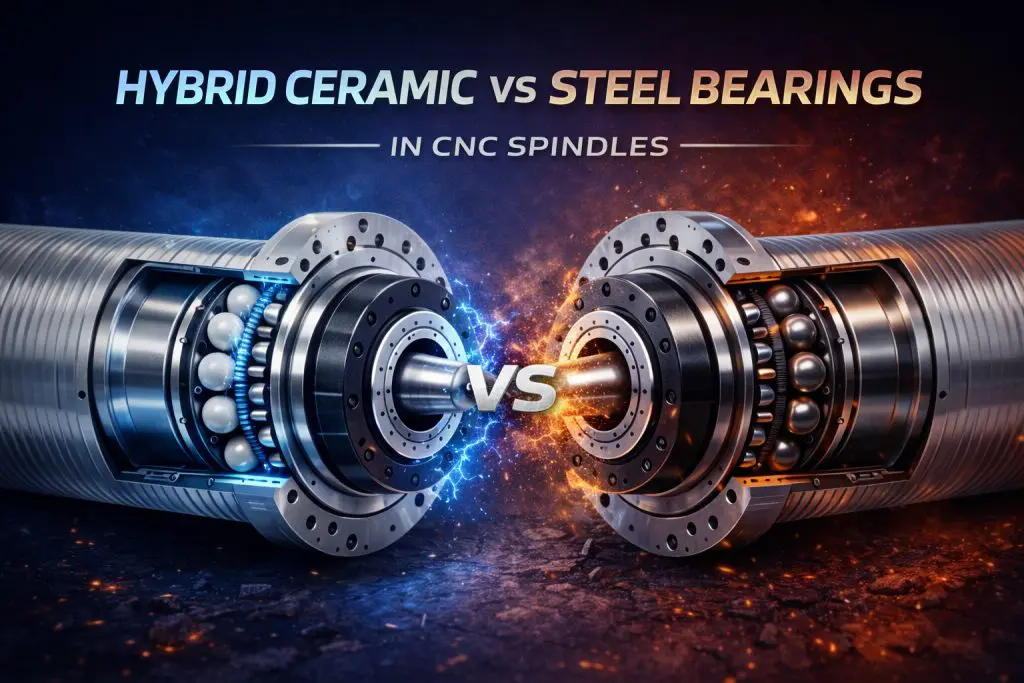
CNC spindle performance depends heavily on bearing selection. Two of the most common options are traditional steel bearings and hybrid ceramic bearings (ceramic balls with steel races).
While both serve important roles, they perform differently under high RPM, heavy load, and thermal stress. Understanding those differences helps determine whether an upgrade makes sense during spindle repair or rebuild.
What Is a Steel Spindle Bearing?
Traditional spindle bearings use:
- Steel balls
- Steel inner and outer races
- Precision ground contact angles
- Matched preload configurations
Steel bearings remain common in:
- General milling spindles
- Heavy torque applications
- Moderate RPM machining
They are reliable, proven, and cost-effective.
What Is a Hybrid Ceramic Bearing?
Hybrid ceramic bearings use:
- Silicon nitride (Si₃N₄) ceramic balls
- Steel races
- Same matched preload systems as steel
They are commonly used in:
- High-speed milling
- 5-axis finishing applications
- Aerospace machining
- High-RPM finishing environments
Hybrid bearings are not fully ceramic — only the rolling elements are ceramic.
Performance Comparison
1️⃣ Heat Generation
Steel Bearings
- Higher friction at elevated RPM
- More heat buildup in sustained high-speed runs
Hybrid Ceramic Bearings
- Lower rolling friction
- Reduced heat generation
- Improved thermal stability
Why this matters:
Heat directly affects preload stability and spindle life.
2️⃣ Maximum RPM Capability
Hybrid ceramic bearings typically allow:
- Higher safe RPM ranges
- Greater high-speed stability
- Reduced centrifugal load on rolling elements
Steel bearings perform very well at moderate speeds but are more sensitive at extreme RPM.
3️⃣ Weight & Centrifugal Force
Ceramic balls are:
- Lighter than steel
- Subject to lower centrifugal forces at high speed
This reduces stress on races and improves stability in high-RPM spindles.
4️⃣ Stiffness & Load Handling
Steel Bearings
- Excellent for heavy torque applications
- Often preferred in steel roughing and high-load conditions
Hybrid Bearings
- Very good stiffness
- Ideal for speed-focused or finish-focused applications
For heavy steel milling, steel bearings may still be preferred.
5️⃣ Wear & Longevity
Hybrid ceramic bearings often provide:
- Longer life at high RPM
- Reduced heat-related degradation
- Better performance in clean, controlled environments
However, both types require proper preload and balance to achieve longevity.
Cost Considerations
Hybrid ceramic bearings typically cost more than steel.
Upgrade decisions should consider:
- Spindle speed requirements
- Thermal performance needs
- Production cycle demands
- Material being machined
For some applications, the added cost provides measurable performance gains. For others, steel remains appropriate.
When Should You Upgrade to Hybrid Ceramic?
Consider upgrading if:
- Your spindle runs at high sustained RPM
- Heat buildup limits performance
- Finish stability matters more than torque
- You operate in aerospace or precision finishing environments
Hybrid ceramic bearings are especially beneficial in:
- High-speed milling
- 5-axis finishing
- High-frequency contouring
When Steel Bearings Are Still the Right Choice
Steel bearings may be preferable when:
- High torque and heavy cuts dominate
- RPM ranges are moderate
- Cost efficiency is a priority
- Thermal stress is not extreme
Many heavy steel milling spindles continue to use steel bearings effectively.
Important: Preload & Assembly Matter More Than Material Alone
Bearing type alone does not determine performance.
Precision spindle performance depends on:
- Correct preload
- Clean assembly environment
- Dynamic balancing
- Shaft and housing condition
- Cooling system integrity
Improper preload can cause:
- Heat
- Premature wear
- Instability
Regardless of bearing type.
Hybrid vs Steel — Quick Comparison
| Factor | Steel Bearings | Hybrid Ceramic Bearings |
|---|---|---|
| Cost | Lower | Higher |
| High-RPM Stability | Moderate | Excellent |
| Heat Generation | Higher | Lower |
| Torque Applications | Excellent | Very Good |
| Longevity at High Speed | Moderate | Improved |
| Best For | Heavy steel cutting | High-speed finishing |
Final Thought
Hybrid ceramic bearings are not automatically “better” — they are application-specific tools.
For high-speed, heat-sensitive machining, they can provide measurable benefits. For heavy torque steel applications, traditional steel bearings remain highly effective.
The right choice depends on spindle design, operating conditions, and production goals.