
Repair FAQs
Why Rebuilt Spindles Often Outperform New Ones
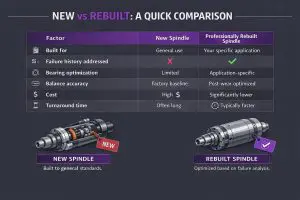
New Vs Rebuilt Spindle: A Comparison
Read MoreCNC Milling Spindle Repair
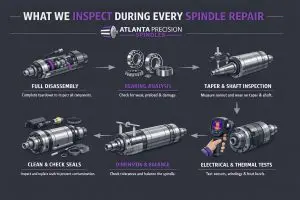
NC milling spindles are the heart of precision machining. When a spindle begins to wear, machine performance, surface finish, and dimensional accuracy are all affected. At Atlanta Precision Spindles, we specialize in CNC milling spindle repair, restoring spindles to OEM—or better—performance while minimizing downtime and extending spindle life. Whether your equipment uses AC or DC…
Read MoreContamination is the silent spindle killer.
Contamination Control in Precision Spindles How Microscopic Contaminants Cause Major Spindle Failures — and How to Prevent Them In precision grinding and high-accuracy machining, spindle failures rarely begin with a dramatic event. Instead, they start quietly—often with contamination that enters the spindle unnoticed and accelerates wear from the inside out. At Atlanta Precision Spindles, contamination-related…
Read MoreBefore Sending a New Spindle Out: What to Check First
Not every vibration or finish issue means a new spindle needs professional balancing at a repair facility. In many grinding applications, the spindle itself may be performing correctly—the issue is often tooling-related balance, not internal spindle imbalance. At Atlanta Precision Spindles, we believe in solving the right problem—not selling unnecessary services. 1. Grinding Wheel Installed…
Read MoreNew Chevalier Spindle Not Balanced? What to Do—and Why It Matters
Installing a new spindle should improve machine performance—not introduce vibration, noise, or finish problems. Yet some shops are surprised to discover that a new Chevalier spindle does not perform as expected, especially at higher RPMs. One common and often overlooked reason is insufficient dynamic balancing. At Atlanta Precision Spindles, we regularly evaluate new and recently…
Read MoreImproving OEM Spindle Performance Through Rebuild

When an OEM spindle starts showing signs of wear, many shops assume their only option is to restore it to “factory condition” or replace it entirely. In reality, a professional spindle rebuild can do more than return performance—it can improve reliability, accuracy, and lifespan beyond the original OEM specification. At Atlanta Precision Spindles, spindle rebuilds…
Read MoreSpindle Dynamic Balancing Process
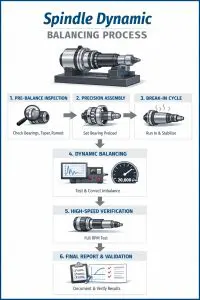
Dynamic balancing is one of the most critical—and often overlooked—steps in professional spindle repair. Even minor imbalance in a high-speed spindle can cause vibration, heat buildup, premature bearing failure, and poor surface finishes. A properly balanced spindle runs smoother, lasts longer, and delivers consistent machining accuracy. Below is an overview of how dynamic spindle balancing…
Read MoreCommon Spindle Myths That Cost Shops Money
CNC spindles are among the most expensive and critical components on a machine tool—yet they’re also one of the most misunderstood. Over the years, several persistent myths have led shops to delay repairs, ignore warning signs, or spend far more than necessary. Let’s break down the most common spindle myths—and explain what they really cost…
Read MoreSigns Your Spindle Needs Repair
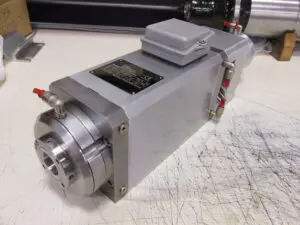
A failing spindle rarely goes from “perfect” to “destroyed” overnight. In most cases, warning signs appear weeks—or even months—before catastrophic failure. Unfortunately, those early indicators are often ignored in the rush of daily production. Catching spindle problems early can mean the difference between a planned repair and an unplanned shutdown, scrapped parts, and a six-figure…
Read More