
GMN HCS 230 Spindle Repair: When Power Reveals Vibration
If you’re researching GMN HCS 230 spindle repair, the spindle likely still runs smoothly at idle or during light grinding — yet vibration or chatter appears when you push the process.
This is a common HCS 230 pattern and usually points to loss of internal stiffness, not poor setup or wheel balance alone.
How the GMN HCS 230 Is Commonly Used
The HCS 230 is typically installed in:
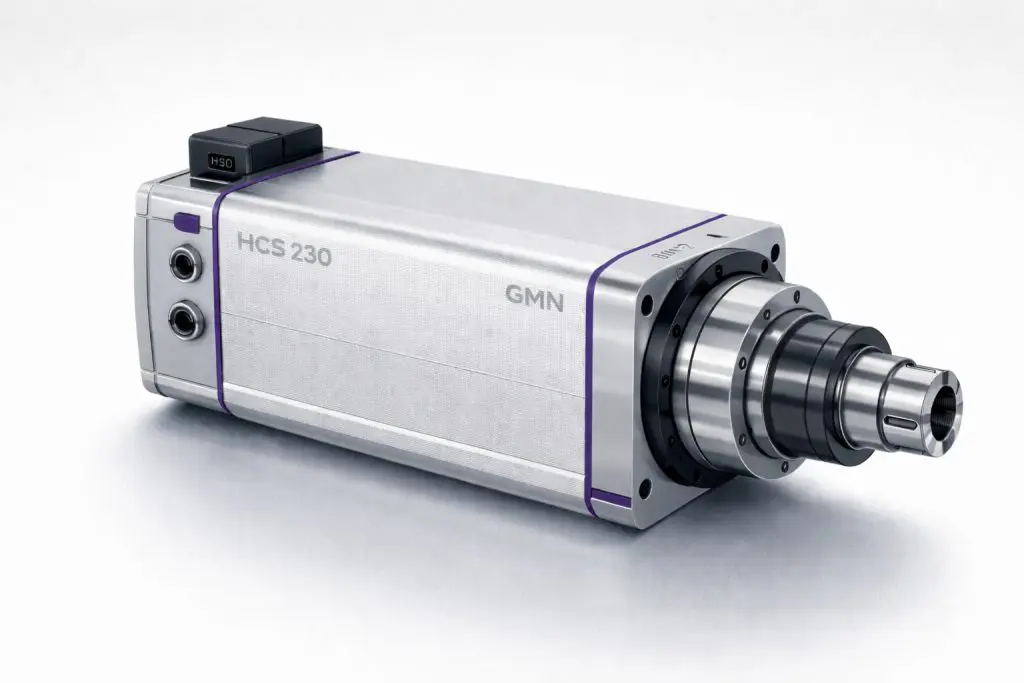
Heavy-duty cylindrical grinding machines
- Production grinding linesApplications requiring higher material removal rates
- Processes where stiffness directly affects part quality
- Heavy-duty cylindrical grinding machines
- Production grinding lines
- Applications requiring higher material removal rates
- Processes where stiffness directly affects part quality
Because of this, internal wear often shows up first under load.
Early Symptoms Seen in HCS 230 Spindles
Vibration during aggressive grinding
Users often report:
- Chatter marks during higher infeed rates
- Finish that degrades as grinding force increases
- Stable behavior during light finishing passes
Reduced process window
As wear progresses:
- Fewer stable parameter combinations exist
- Operators back off feeds to maintain finish
- Cycle times increase
What’s Typically Happening Inside the HCS 230
Bearing wear reducing stiffness
As bearings degrade:
- Radial stiffness drops
- Cutting forces excite vibration more easily
- Stability depends increasingly on reduced load
This makes the spindle feel “fine” until it’s pushed.
Why HCS 230 Issues Are Often Misdiagnosed
Most users first adjust:
- Wheel balance or dressing strategy
- Grinding parameters
- Machine support or fixturing
While these matter, repeated vibration under load often points back to the spindle itself.
Repair Options for GMN HCS 230 Spindles
Load-focused spindle evaluation
A proper evaluation can:
- Measure vibration relative to applied load
- Assess bearing stiffness
- Identify internal wear early
Precision bearing rebuild
When bearing wear is confirmed:
- Bearings are replaced and correctly preloaded
- Radial stiffness is restored
- Vibration under load is reduced or eliminated
Why Reducing Aggressiveness Gets Expensive
Running at reduced parameters:
- Cuts productivity
- Masks spindle deterioration
- Leads to larger, more costly repairs later
High-power spindles are meant to be used — not avoided.
Manufacturer-Recommended Maintenance for the GMN HCS 230
GMN’s documentation for high-speed grinding spindles emphasizes maintenance practices that preserve stiffness and bearing life under load.
Manufacturer guidance generally includes:
- Maintaining correct lubrication conditions
- Allowing proper warm-up before aggressive grinding
- Monitoring vibration and stability under load
- Avoiding prolonged operation at excessive grinding forces
- Inspecting spindle behavior regularly
For complete specifications and maintenance instructions, consult GMN’s official documentation.
👉 Reference:
GMN High-Speed Grinding Spindle Documentation
https://www.gmn.de/en/products/spindles/high-speed-spindles/
Preventative Practices That Help HCS 230 Spindles Last Longer
To extend service life:
- Track vibration trends as grinding load increases
- Address instability early instead of backing off indefinitely
- Maintain consistent lubrication and warm-up routines
In high-power grinding, stiffness is everything.
If your GMN HCS 230 vibrates only when pushed, an evaluation can help determine whether internal stiffness loss is already limiting performance.
Illustration Disclaimer
Illustrations are representative and used for educational purposes; actual spindle configurations may vary.