
IBAG HF300 Spindle Repair: Stability and Power Under Load
The IBAG HF300 is designed for applications that demand both precision and rigidity under significant cutting loads. When internal conditions begin to change, performance rarely degrades across the board. Instead, users often notice selective issues—vibration appearing during aggressive machining, finish quality breaking down under load, or a shrinking stable process window—while the spindle itself continues to sound normal. These patterns frequently indicate internal bearing or stiffness-related wear rather than tooling or programming issues.
How the IBAG HF300 Is Typically Used
The HF300 is commonly installed in high-demand milling and hybrid machining applications where torque and rigidity matter as much as accuracy. With tooling interfaces such as HSK100A and BT50, this spindle is intended to transmit substantial cutting forces without compromising stability.
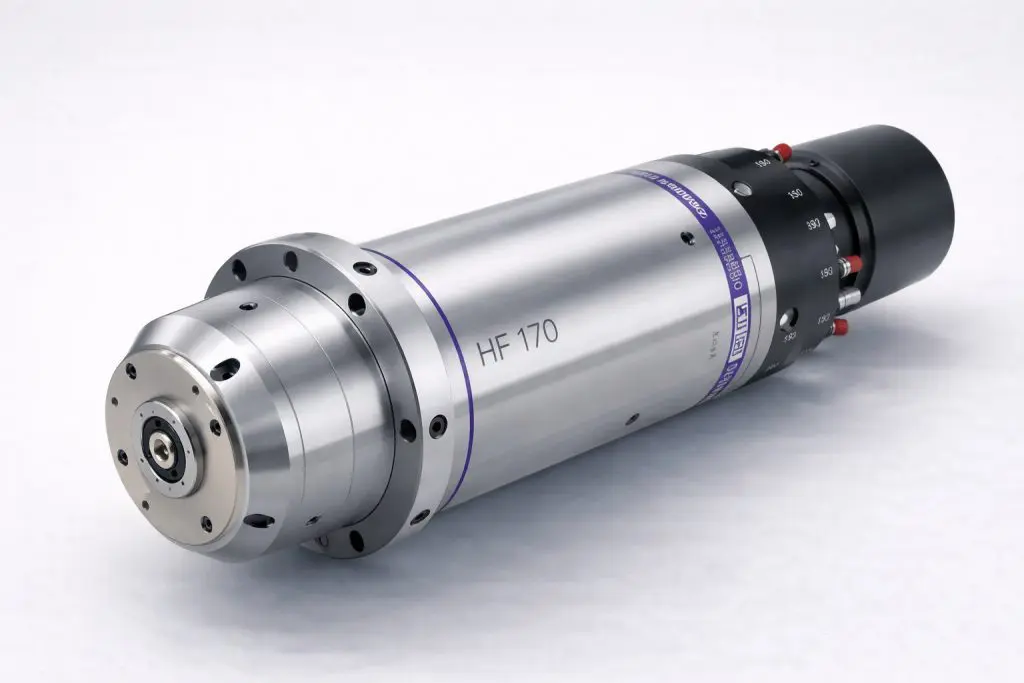
Typical applications include:
- Heavy-duty milling operations
- Precision machining requiring high torque at moderate speeds
- Production environments where sustained load is unavoidable
- Operations pushing larger tools or deeper cuts
In these conditions, the HF300’s mechanical health directly determines process stability.
Performance Characteristics That Shape HF300 Behavior
The HF300’s design places it firmly in the high-torque, high-rigidity category, which influences how wear presents over time.
Key operating characteristics include:
- Maximum speed: up to 12,000 RPM
- Continuous-duty power (S1-100%): approximately 30 kW
- Intermittent-duty power (S6-40%): up to 39 kW
- Continuous-duty torque (S1-100%): approximately 238.8 Nm
- Intermittent-duty torque (S6-40%): exceeding 310 Nm
- Grease-lubricated bearing operation: up to approximately 11,000 RPM
Because the HF300 is capable of delivering high torque for extended periods, bearing condition and preload integrity are critical to maintaining stiffness.
Early Symptoms Seen in HF300 Spindles
Instability under cutting load
Users often report:
- Smooth operation at idle or during light cuts
- Vibration or chatter appearing only during heavier machining
- Finish quality degrading as torque demand increases
Narrowing process window
As internal wear progresses:
- Parameters that once worked reliably become unstable
- Operators reduce depth of cut or feed rates to maintain finish
- Productivity declines without a clear external cause
These symptoms are rarely visible during no-load testing.
What’s Typically Happening Inside the HF300
Loss of stiffness from bearing wear
As bearings wear under sustained torque:
- Radial and axial stiffness gradually decrease
- Cutting forces excite vibration more easily
- Stability becomes increasingly load-dependent
Because the HF300 is designed to handle high torque, even small reductions in stiffness become noticeable during demanding operations.
Why HF300 Issues Are Often Misdiagnosed
Initial troubleshooting usually focuses on:
- Tooling and toolholders
- Feeds, speeds, and depth of cut
- Fixturing or workholding rigidity
While these factors matter, repeated instability that correlates with load—not speed—often indicates internal spindle wear, not setup issues.
Repair Options for IBAG HF300 Spindles
Load-focused spindle evaluation
A proper evaluation can:
- Assess bearing condition relative to torque demand
- Identify stiffness loss before secondary damage occurs
- Prevent unnecessary compromises in machining parameters
Precision bearing rebuild and dynamic balancing
When wear is confirmed:
- Bearings are replaced to OEM-level specifications
- Preload and stiffness are restored
- Dynamic balance is verified for stability across the operating range
The result is a spindle that can again support high torque without vibration.
Manufacturer-Recommended Maintenance for IBAG HF Spindles
According to manufacturer guidance for IBAG high-frequency spindles, maintaining stiffness and accuracy under load depends heavily on correct operation and preventative care.
Manufacturer recommendations generally emphasize:
- Proper warm-up before high-torque machining
- Avoiding unnecessary shock loads during tool changes or engagement
- Maintaining clean, stable cooling conditions
- Monitoring vibration and finish trends over time
- Addressing performance changes early rather than compensating indefinitely
👉 Reference:
IBAG North America – Downloads & Documentation
https://www.ibagnorthamerica.com/downloads
Users can locate the appropriate manuals and technical resources by spindle model or series within the OEM documentation library.
Preventative Practices That Help HF300 Spindles Last Longer
To preserve stiffness and performance:
- Track vibration relative to torque demand, not just RPM
- Avoid permanently reducing parameters to mask instability
- Investigate load-related changes early
High-torque spindles are designed to work hard — not to be worked around.
If your IBAG HF300 runs smoothly at idle but becomes unstable under heavier cuts, an evaluation can help determine whether internal bearing wear is already limiting stiffness and torque capability.
Illustrations are representative and used for educational purposes; actual spindle configurations may vary.