
Mazak Spindle Design Comparison
Comparing Integral, Belt-Driven, and Tilt / Angular Spindle Designs
Mazak machines use different spindle designs depending on speed, torque, and machining flexibility requirements. While the machine platform may remain mechanically sound for decades, the spindle design determines how wear develops and how symptoms appear.
This comparison page helps identify which spindle design is in use, what each design prioritizes, and how performance issues typically present before failure.
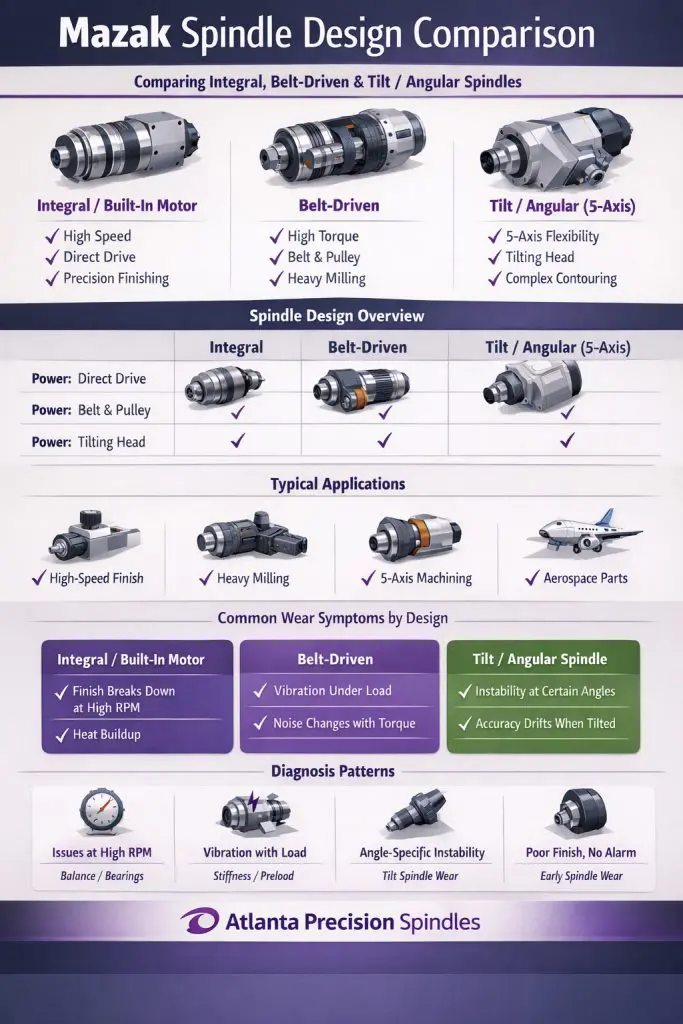
Why Compare Spindle Designs Instead of Models
Mazak spindle issues are often misdiagnosed because:
- Different spindle designs fail differently
- Symptoms vary by speed, load, and orientation
- The machine continues to operate even as spindle performance degrades
Comparing spindle designs by behavior and application makes it easier to identify when the spindle—not tooling or programming—is the root cause.
Mazak Spindle Design Comparison Table
Spindle Design Overview
| Feature / Behavior | Integral / Built-In Motor | Belt-Driven | Tilt / Angular (5-Axis) |
|---|---|---|---|
| Power Transmission | Direct-drive (motor in spindle) | External motor with belts | Direct-drive or integrated motor in pivoting head |
| Primary Strength | High speed, smooth rotation | High torque, load handling | Multi-axis flexibility |
| Typical RPM Range | High to ultra-high | Low to mid | Varies by orientation |
| Acceleration | Very fast | Moderate | Moderate |
| Mechanical Complexity | Moderate | Lower | High |
| Sensitivity to Balance | Very high | Moderate | High (orientation dependent) |
| Sensitivity to Load | Moderate | High | Variable by angle |
Typical Applications
| Application Type | Integral | Belt-Driven | Tilt / Angular |
|---|---|---|---|
| High-speed finishing | ✔️ | ❌ | ✔️ |
| Heavy roughing | ❌ | ✔️ | ⚠️ (angle dependent) |
| Aerospace / medical | ✔️ | ❌ | ✔️ |
| Continuous 5-axis machining | ❌ | ❌ | ✔️ |
| Torque-intensive milling | ❌ | ✔️ | ⚠️ |
✔️ = Well suited
⚠️ = Application dependent
❌ = Not typically optimized
Common Wear Symptoms by Design
| Symptom Observed | Most Likely Spindle Design |
|---|---|
| Finish degrades at high RPM | Integral / built-in motor |
| Vibration increases with cutting load | Belt-driven |
| Noise changes with torque demand | Belt-driven |
| Heat buildup during long runs | Integral or belt-driven |
| Instability only at certain angles | Tilt / angular |
| Accuracy drift during 5-axis motion | Tilt / angular |
| Narrowing usable RPM range | Integral or tilt |
How Problems Commonly Present
| Behavior Pattern | Likely Root Cause |
|---|---|
| Issues tied to RPM, not feed | Balance or bearing condition |
| Problems only during cutting | Spindle stiffness or preload |
| Stable vertical, unstable tilted | Angular spindle wear |
| Quiet operation but poor results | Early spindle wear |
These patterns help separate spindle condition from machine or control issues.
Why Spindle Design Affects Diagnosis
Each spindle design prioritizes different performance characteristics:
- Integral spindles reveal wear through speed-related symptoms
- Belt-driven spindles reveal wear through load-related symptoms
- Tilt spindles reveal wear through orientation-dependent behavior
Understanding this prevents:
- Unnecessary tooling changes
- CAM rework that doesn’t solve the issue
- Machine-level troubleshooting when the spindle is the source
Repair vs Replacement — Design Matters
Spindle design influences repair decisions:
- Integral spindles benefit from early repair before thermal damage escalates
- Belt-driven spindles are often cost-effective to restore when stiffness loss is caught early
- Tilt spindles require careful evaluation due to orientation-dependent wear
In many cases, professional spindle repair restores performance without full replacement, especially when symptoms are addressed early.
Manufacturer Guidance (Context)
Mazak’s spindle rebuild and service guidance emphasizes that spindle condition directly affects accuracy, vibration behavior, and thermal stability, and that identifying performance changes early helps limit repair scope and downtime.
👉 OEM reference:
Mazak Spindle Rebuild & Service Overview (PDF)
https://www.mazak.com/content/dam/mazak/exported_files/global_web/us/en_US/support/SpindleRebuild_Brochure_2020.pdf