
SKF spindle overheating

SKF Spindle Overheating · Diagnostic Guide

SKF Spindle Overheating: Causes & Diagnosis

Overheating in an SKF-equipped spindle is never random. Whether your spindle runs 719-series or 70-series super-precision bearings — in all-steel or hybrid-ceramic (HC) form — heat rise is usually the first sign of preload imbalance, lubrication breakdown, contamination, or internal friction. In high-RPM VMC and grinding work, small shifts in preload or lubrication amplify fast. Atlanta Precision Spindles services the spindle assembly only, restoring preload integrity, balance, and stable thermal behavior.
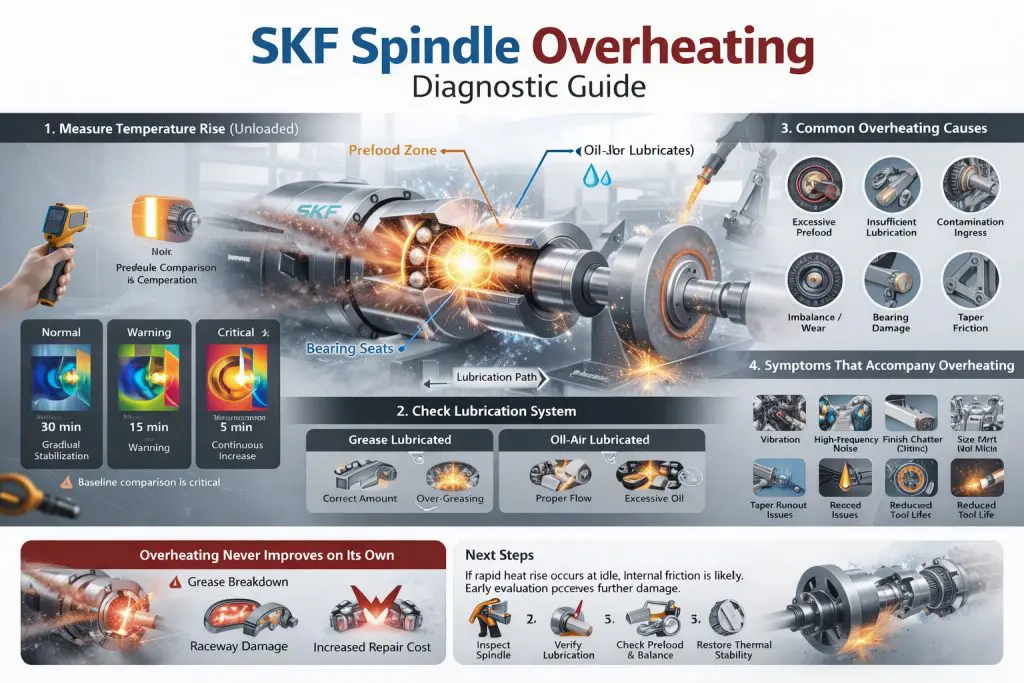
Heat Is a Readout, Not the Disease

On SKF super-precision systems, overheating is almost always an assembly story — preload or lubrication — not simply a worn bearing. Heat is the earliest readout of that drift, and the higher-performance the bearing, the faster it tells you: hybrid-ceramic (HC) sets run cooler when they’re right, but they punish small preload or lubrication errors faster than steel. The single most useful signal is change from baseline — if the spindle runs hotter than it used to under identical cutting conditions, something has shifted internally.

Reading the Heat

What Temperature Is Too Hot?

Read the behavior, not just the number:

  • Warm and stable under load → normal
  • Gradual rise that then stabilizes → normal
  • Rapid heat rise at idle → warning sign
  • Keeps climbing without stabilizing → internal friction issue

For context on the upper end: the standard fabric-reinforced phenolic cages used in these bearings are rated to roughly 120 °C (250 °F), so sustained bearing temperatures approaching that range are well outside the healthy window. But the threshold that matters most is your own baseline — a spindle that has started running hotter under identical conditions is already telling you something changed.

Decoder

Reading Your SKF Bearing Designation

The number stamped on the bearing tells you most of what drives its thermal behavior. A designation like 71914 ACD/HCP4ADGA breaks down as follows:

Element Example What It Tells You
Series 719xx / 70xx Super-precision angular contact ball bearing. The 719 series carries more balls for higher stiffness; both are standard in electro-spindles and machine tools.
Size code …14 Bore in millimetres ÷ 5 (so 14 = 70 mm bore).
Contact angle AC (25°) / A A larger contact angle adds axial stiffness but reduces speed capability.
Design D / E / B D = high-capacity; E and B = high-speed designs.
Ball material HC Hybrid — silicon nitride (Si₃N₄) ceramic balls with steel rings. No HC = all-steel.
Tolerance P4A ISO tolerance class 4 (super-precision); P4B is tighter still.
Preload GA / GB / GC Universally matchable light / moderate / heavy preload. A “G” + number (e.g. G240) is a special preload in daN.

Why this matters for heat: the preload class and whether the set is hybrid (HC) largely determine the spindle’s thermal margin. Mixing mismatched preload classes, omitting the correct precision spacers, or swapping steel for hybrid without revisiting preload all change how much heat the assembly makes.

Causes

Common Causes of SKF Spindle Overheating

1. Preload Imbalance

Preload is set by matched bearing sets and precision spacers, so it’s easy to get wrong on reassembly — and it cuts both ways:

  • Too much preload: excess friction, rapid heat buildup, grease breakdown.
  • Too little preload: micro-skidding, surface distress, secondary heat rise.

Hybrid ceramic systems (719xx/70xx HC) are especially sensitive to preload error — their lighter ceramic balls and lower friction leave less thermal margin to absorb a mistake.

2. Lubrication Problems

Lubrication errors are one of the most common overheating causes, and the failure mode depends on the system:

  • Over-greasing: churning drag and elevated operating temperature.
  • Incorrect grease type: poor film strength at speed, thermal instability.
  • Oil-air systems: too much oil drives heat; too little causes surface distress.

3. Contamination Ingress

Coolant mist, fine chips, or grinding dust can degrade lubricant, increase friction, pit raceways, and accelerate heat rise. Grinding spindles are particularly vulnerable to abrasive contamination.

4. Rotor Imbalance

As bearings degrade, balance shifts, vibration increases, and heat rises with RPM. Heat and vibration usually travel together — if you see one climbing, check for the other.

5. Taper or Tool-Interface Issues

In VMC spindles (CAT40 / ISO30), tool seating problems, taper fretting, and pull-stud inconsistency increase friction load and elevate operating temperature — heat that originates at the interface, not the bearings.

Diagnostic Tip

Heat at idle points inward — preload, lubrication, or contamination inside the spindle. Heat that only appears with a tool loaded points outward — to the taper or tool interface. Running unloaded across the RPM range separates the two before anything comes apart.

Hybrid vs. Steel

Hybrid Ceramic vs. Steel: Heat Differences

Property Hybrid (HC) 719xx / 70xx Steel 70xx / 719xx
Ball material Silicon nitride (Si₃N₄) ceramic — lighter Carbon-chromium steel
Friction at speed Lower Slightly higher
Speed capability Higher Moderate
Load tolerance More sensitive to preload & lubrication More tolerant of load
Heat behavior Runs cooler when correct; punishes preload or lube drift fast More forgiving, but still sensitive to incorrect assembly

Bottom line: if a hybrid spindle suddenly runs hotter than normal, preload or lubrication drift is usually involved.

Symptoms

Symptoms That Accompany Overheating

Overheating rarely occurs alone — it usually arrives with other performance degradation:

  • Vibration increasing with RPM
  • High-frequency bearing whine
  • Finish chatter
  • Dimensional drift in grinding
  • Measurable taper runout
  • Reduced tool life

Checklist

Quick Diagnostic Checklist

Before removing the spindle:

  • Run unloaded across multiple RPM ranges
  • Measure temperature rise over time
  • Check the lubrication system (if oil-air)
  • Inspect tooling and holders
  • Compare against the previous baseline temperature

If temperature rises rapidly at idle, internal spindle friction is the likely cause.

Cost of Waiting

What Happens If You Keep Running It Hot?

  • Grease breakdown accelerates
  • Bearing surfaces pit
  • Preload changes
  • Rotor balance shifts
  • Shaft damage risk increases

Caught early, the repair is often limited to bearings and seals. Left running hot, the damage spreads to the shaft and housing — turning a contained bearing job into a full rebuild.

Our Approach

Our Approach to Overheating SKF Spindles

The goal is a stable operating temperature at target RPM. Our work focuses on:

  • Bearing designation verification
  • Preload class confirmation
  • Controlled assembly procedures
  • Lubrication evaluation
  • Dynamic balance correction
  • Runout verification
  • Thermal stabilization testing

What We Repair

Atlanta Precision Spindles services the spindle assembly only — not the CNC or grinding machine, its frame, controls, drives, or motion components. If the spindle assembly is running hot, that is exactly what we restore.

Restore Thermal Stability

If your SKF-based spindle is running hotter than normal, early evaluation can prevent internal damage and reduce downtime. Tell us the bearing designation (if you have it) and your operating symptoms. Call (678) 225-7855 or send the details.

Request a Spindle Evaluation →

Related: Spindle Repair · Spindles We Repair · Contact Us.

pindle overheating faq schema · TXT

Questions

Frequently Asked Questions

How hot is too hot for an SKF spindle?

The most reliable indicator isn’t an absolute number — it’s change from baseline. If the spindle now runs hotter than it did under identical cutting conditions, something has shifted internally. For an upper bound, the standard phenolic cages in these bearings are rated to roughly 120 °C (250 °F), so sustained temperatures approaching that range are well outside the healthy window. Behavior matters too: warm-and-stable or a gradual rise that levels off is normal; rapid heat at idle or temperature that keeps climbing is a warning sign.

What do the letters in my SKF bearing number (HC, P4A, GA) mean?

The designation tells you most of what drives thermal behavior. The 719xx and 70xx series are super-precision angular contact bearings (719 carries more balls for higher stiffness). HC means a hybrid bearing with silicon nitride (Si₃N₄) ceramic balls; no HC is all-steel. P4A is the ISO class-4 super-precision tolerance. GA, GB, and GC are light, moderate, and heavy preload for universally matchable bearings, while a “G” followed by a number (such as G240) is a special preload in daN. Preload class and whether the set is hybrid largely set the spindle’s thermal margin.

Why does my hybrid ceramic spindle suddenly run hotter than before?

Hybrid ceramic (HC) sets run cooler and faster than steel when they’re correct, but their lighter ceramic balls and lower friction leave less thermal margin — so they punish preload or lubrication drift faster. A hybrid spindle that has started running hot usually has preload that has shifted, the wrong or excess lubricant, or contamination raising internal friction. The fix is correct preload and lubrication, not just new bearings.

Is overheating caused by the bearings, or by preload and lubrication?

On SKF super-precision spindles it’s usually preload or lubrication, not a simply worn bearing. Too much preload adds friction and heat; too little causes micro-skidding and secondary heat. Over-greasing, the wrong grease, or an out-of-balance oil-air system all raise temperature. Contamination and taper or tool-interface problems add to it. Heat is the earliest readout that one of these has drifted.

What should I check before pulling the spindle?

Run the spindle unloaded across multiple RPM ranges, measure temperature rise over time, check the lubrication system if it’s oil-air, inspect the tooling and holders, and compare against the previous baseline temperature. Heat at idle points to internal friction (preload, lubrication, contamination); heat that only appears with a tool loaded points to the taper or tool interface.

Can overheating be fixed without replacing the whole spindle?

Often, yes — if it’s caught early. When the cause is addressed before heat damages the shaft and housing, the repair is usually limited to bearings and seals with corrected preload and lubrication. Running a spindle hot accelerates grease breakdown, pits bearing surfaces, shifts preload and balance, and raises shaft-damage risk, which expands a contained bearing job into a full rebuild.

Do you repair the CNC or grinding machine itself?

No. Atlanta Precision Spindles services the spindle assembly only — not the CNC or grinding machine, its frame, controls, drives, or motion components. If the spindle assembly is running hot, that is the part we evaluate and restore.