
Is It the Spindle or the Router?
MultiCam Diagnostic Guide for Finish, Vibration, and Accuracy Issues
When a MultiCam 3000 Series (or similar router) starts producing poor finish, inconsistent edges, or vibration at higher RPM, the first question most shops ask is:
Is the problem the machine… or the spindle?
Because the spindle is the highest-speed, most precision component on the router, it’s often the source of subtle performance degradation — even when no alarms are present.
This guide helps you isolate the issue before scheduling service.
Step 1: Identify the Type of Symptom
Different problems point to different components.
🔹 Finish Quality Declines (But No Loud Noise)
Common signs:
- Fuzzy MDF edges
- Laminated panel chipping
- Increased sanding time
- Slight waviness in aluminum
If:
- The machine still positions accurately
- Axis movement feels smooth
- No visible gantry shake
👉 The spindle bearings may be wearing.
Router frames typically cause alignment issues — not high-speed finish instability.
🔹 Vibration at Specific RPM Ranges
If the router runs fine at:
- 12,000 RPM
But becomes unstable at:
- 18,000–24,000 RPM
That strongly suggests:
- Bearing preload degradation
- Dynamic imbalance
- Early spindle instability
Machine structural issues usually affect all speeds — not specific RPM bands.
🔹 Heat Buildup in the Spindle
If
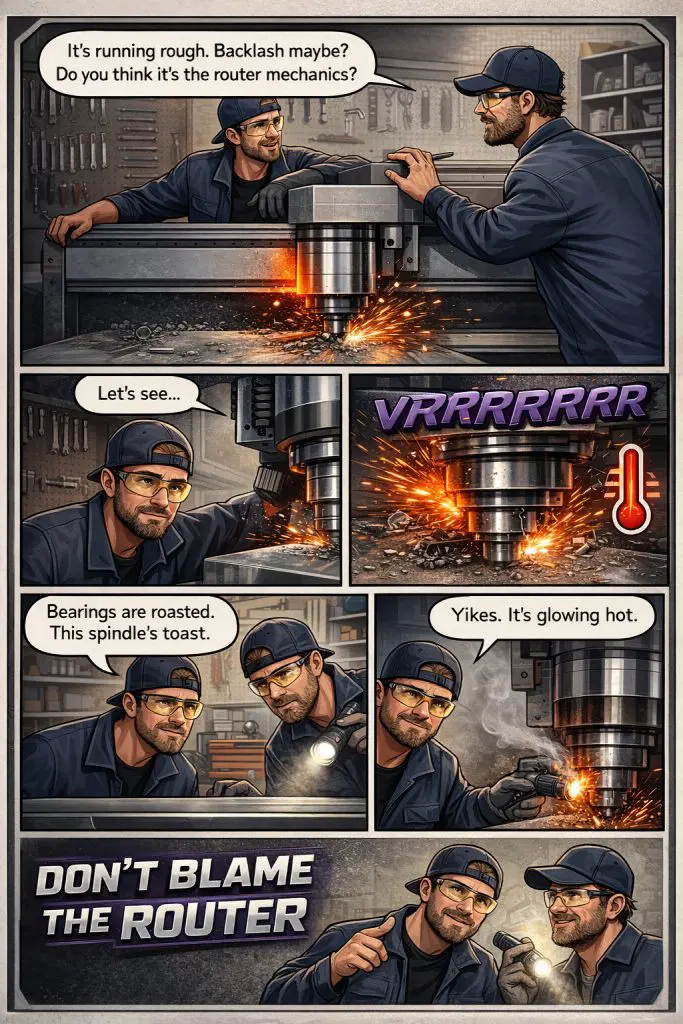
If spindle housing feels noticeably hotter than normal after extended runs:
- Cooling air may be contaminated
- Bearings may be creating friction
- Preload may be tightening due to thermal growth
Router mechanical issues rarely cause localized spindle heat.
🔹 Positional Accuracy Issues
If you see:
- Misalignment in corners
- Step loss
- Inconsistent axis travel
- Repeatability problems
Those usually point to:
- Servo tuning
- Rack & pinion wear
- Linear guides
- Frame alignment
That’s router-side, not spindle.
Quick Diagnostic Comparison
| Symptom | More Likely Spindle | More Likely Router |
|---|---|---|
| High-RPM vibration only | ✅ | |
| Finish degradation without axis error | ✅ | |
| Excessive spindle heat | ✅ | |
| Inconsistent positioning | ✅ | |
| Gantry shake at all speeds | ✅ | |
| Tool life drops across all tools | ✅ |
Step 2: The Speed Test
One of the simplest diagnostic tools:
Run the same toolpath at:
- Low RPM
- Medium RPM
- High RPM
If instability increases proportionally with speed, it is very likely spindle-related.
Router structural problems tend to show consistently regardless of RPM.
Step 3: Check Tool Runout
Using a dial indicator:
- Measure runout at the taper
- Compare to historical baseline
Excessive runout often indicates:
- Bearing wear
- Taper fretting
- Internal preload loss
Runout does not come from axis motors.
Why MultiCam Router Spindles Wear
Most MultiCam routers operate in:
- MDF environments
- Composite cutting
- Aluminum routing
- High-volume cabinet production
Spindles in these environments:
- Run sustained high RPM
- Face dust contamination
- Depend on clean cooling air
Over time, contamination and thermal stress degrade bearing surfaces.
When It’s Definitely the Spindle
You likely need spindle service if:
- RPM-specific vibration exists
- Finish quality declines gradually
- Heat increases
- Tool life shortens
- There are no positioning errors
These are classic early-stage bearing wear signs.
When It’s Likely the Router
Consider machine service if:
- Axis positioning is inconsistent
- Gantry visibly shakes
- Cut depth changes across table
- Mechanical backlash is present
These issues point to structural components.
Important: Don’t Wait for Failure
Many shops wait until:
- Loud bearing noise
- Alarm shutdown
- Catastrophic failure
By then, a Level 2 repair may escalate to a full rebuild.
Early diagnostic awareness keeps repair costs controlled.
Final Thought
If the issue changes with RPM, it’s usually the spindle.
If the issue changes with axis movement, it’s usually the router.
Understanding the difference prevents unnecessary downtime — and avoids replacing parts that aren’t the problem.
- MultiCam 7000 Series Spindle RepairHigh-Duty Router Spindle Rebuild for Industrial Production The MultiCam 7000 Series is engineered for high-production routing environments where rigidity, power, and uptime matter. These machines…
- MultiCam 5000 Series Spindle RepairRestoring Stability, Finish Quality, and High-RPM Performance The MultiCam 5000 Series is built for industrial CNC routing environments where rigidity, speed, and production volume matter.…
- Is It the Spindle or the Router?
 MultiCam Diagnostic Guide for Finish, Vibration, and Accuracy Issues When a MultiCam 3000 Series (or similar router) starts producing poor finish, inconsistent edges, or vibration…
 - MultiCam 3000 Series Spindle RepairWhen Finish Quality Drops or Vibration Starts The MultiCam 3000 Series is widely used in CNC routing for wood, plastics, aluminum, and composite materials. Known…
Frequently Asked Questions
How can I tell if my MultiCam issue is caused by the spindle or the router?
If the problem changes with spindle RPM—such as finish degrading at higher speeds, vibration appearing only in certain RPM ranges, or heat building at the spindle housing—the spindle is often the source. If the issue is tied to axis motion, positioning, or backlash regardless of RPM, it is more likely router-related.
Why does my finish quality decline without obvious vibration or noise?
Router spindles can degrade quietly. Small changes in bearing condition, preload, or effective runout often show up first as finish and edge-quality issues before vibration becomes obvious or alarms appear.
What does vibration at specific RPM ranges usually mean?
Vibration that appears only at certain RPM ranges commonly indicates spindle-related issues such as bearing wear, preload changes, or dynamic imbalance. Machine structural issues typically affect performance more consistently across speeds.
If the spindle is running hot, is that a sign of bearing wear?
Often, yes. Increased heat can indicate rising internal friction from bearing wear or preload changes, especially during long production runs. Cooling airflow, contamination, and duty cycle can also influence temperature.
What router symptoms are more likely machine-related than spindle-related?
Inconsistent positioning, backlash, visible gantry shake, depth variation across the table, or issues that occur regardless of spindle RPM are more commonly caused by router-side components such as drives, guides, or structural alignment.
Can I diagnose a spindle problem with a simple RPM test?
Yes. Running the same toolpath at low, medium, and high RPM can be revealing. If the issue intensifies with higher RPM, the spindle is often involved. If the issue stays consistent regardless of RPM, the router mechanics may be the cause.
Should I keep running the machine until the spindle fails?
Waiting can increase the risk of secondary damage and expanded repair scope. If you are seeing finish decline, heat trend increases, or speed-specific instability, early evaluation often prevents more costly repairs and unplanned downtime.