
BT40 SKF Spindle Repair
(High-Speed Vertical Machining Centers • 10,000–20,000+ RPM)
BT40 spindles are common in high-speed vertical machining centers where balanced toolholders, consistent taper contact, and stable thermal behavior are critical. Many BT40 cartridges use SKF super-precision bearing systems, typically from the 70xx or 719xx (often hybrid ceramic) series.
Atlanta Precision Spindles rebuilds the spindle assembly only, restoring preload integrity, dynamic balance, and taper accuracy for stable high-RPM performance.
Where BT40 SKF Spindles Are Common
- High-speed production VMCs
- Mold & die machining
- Aerospace component milling
- Aluminum and light-alloy machining
- Toolroom and precision environments
Typical operating ranges:
- 10,000–12,000 RPM (general production)
- 15,000–20,000+ RPM (high-speed configurations)
At these speeds, minor preload or lubrication errors quickly affect finish and tool life.
Common SKF Bearing Configurations in BT40 Spindles
70xx Series (Stiffness-Focused)
Often used in torque-oriented or moderate-speed BT40 systems.
Common sizes:
- 7012
- 7014
- 7016
- 7018
Typical arrangements:
- Back-to-back (DB) matched sets
- Triplex configurations in higher load spindles
Advantages
- High axial rigidity
- Good load capacity
- Stable under heavier cutting loads
719xx Series (High-Speed / Hybrid Variants)
More common in high-speed BT40 systems.
Common sizes:
- 71912
- 71914
- 71916
- 71918
Frequently hybrid ceramic (HC) configurations for:
- Lower rolling mass
- Reduced centrifugal force
- Higher maximum RPM capability
Hybrid systems require extremely controlled preload and lubrication.
Unique Failure Factors in BT40 Spindles
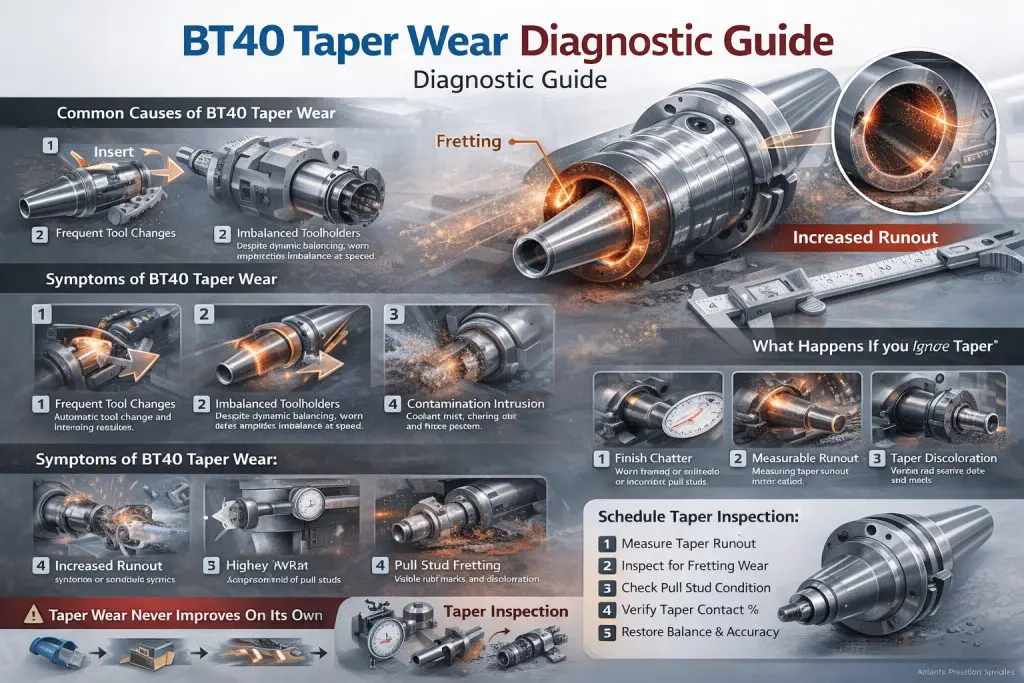
1️⃣ Taper & Toolholder Balance Sensitivity
BT40 systems depend heavily on balanced tooling.
Imbalance can cause:
- Vibration at speed
- Heat rise
- Reduced bearing life
- Finish chatter
At 15k–20k RPM, balance becomes critical.
2️⃣ Overheating
Often caused by:
- Excess preload
- Over-greasing
- Oil-air imbalance
- Bearing friction increase
Rapid heat rise at idle is an early warning.
3️⃣ Tool Change Wear
Frequent automatic tool changes may lead to:
- Taper fretting
- Tool seating inconsistency
- Pull stud wear
- Runout growth
Often mistaken for spindle bearing failure.
4️⃣ Coolant Intrusion
High-pressure coolant systems can:
- Degrade lubricant
- Introduce contamination
- Accelerate raceway pitting
Contamination is a leading cause of premature SKF bearing fatigue.
Warning Signs Your BT40 SKF Spindle Needs Service
- Spindle running hotter than baseline
- Vibration increasing with RPM
- High-frequency bearing whine
- Surface finish degradation
- Measurable taper runout
- Reduced tool life
Hybrid 719xx systems often show thermal instability first.
70xx systems often show vibration growth first.
Our BT40 SKF Spindle Rebuild Process
We focus on restoring engineered stiffness and taper integrity.
Our rebuild process includes:
- Bearing designation verification
- Preload class confirmation
- Matched super-precision bearing replacement
- Controlled axial clamping procedures
- Dynamic balance correction
- Seal inspection and contamination mitigation
- Taper inspection and runout verification
- Thermal stabilization testing
The objective: stable high-speed rotation with controlled temperature rise.
Repair vs Replacement
Full BT40 spindle cartridge replacement can involve significant cost and downtime.
A precision rebuild is often appropriate when:
- Shaft and housing are within recoverable tolerance
- Bearing wear is primary failure
- Motor components remain intact
Rebuild restores preload and balance without replacing the entire cartridge.
Atlanta Precision Spindles repairs the spindle assembly only — not the CNC machine.