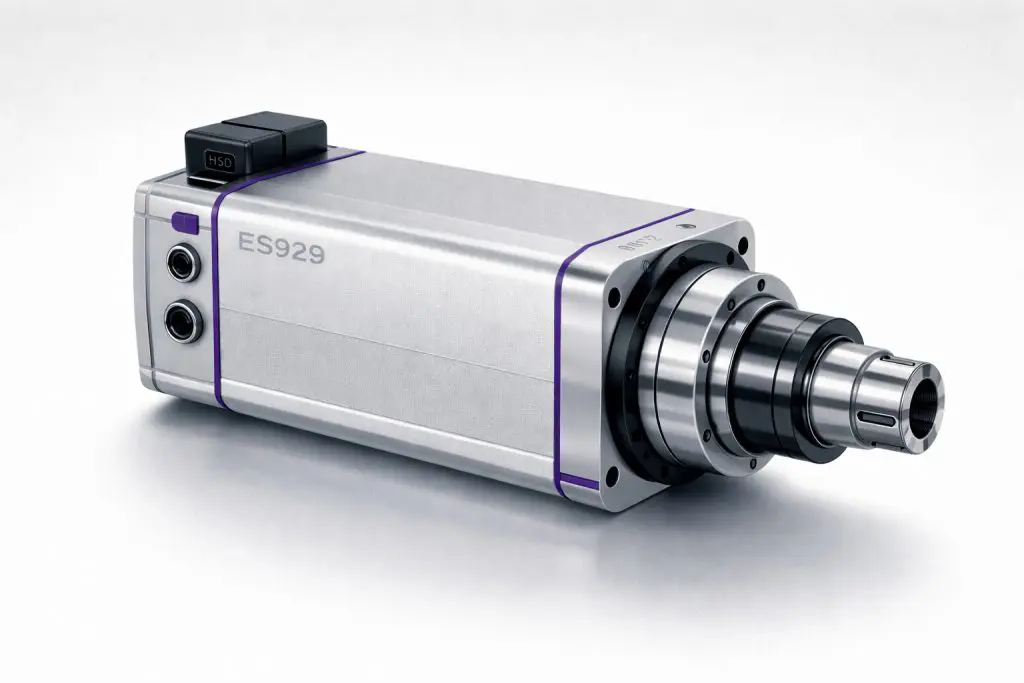
HSD ES929 Spindle Repair: When Aluminum Cutting Starts Causing Chatter

HSD ES Series Spindle Repair

HSD ES929 Spindle Repair and Rebuild

The ES929 tends to fail in a specific pattern: it performs acceptably in wood or plastics, then begins to chatter or vibrate noticeably when cutting aluminum or handling heavier loads. That pattern usually points to load-related stiffness loss inside the spindle — not just tooling or programming. This page covers why it happens, how to confirm the spindle is the source, and how repair decisions are made.

Atlanta Precision Spindles inspects every ES929 before quoting. The rebuild scope is set by what the inspection finds — there is no standard rebuild, because no two spindles arrive in the same condition.

Operating Context

How the HSD ES929 Is Commonly Used

The ES929 is frequently used in mixed-material environments:

Wood and composite machining

Lower cutting forces mean a worn spindle can still produce an acceptable finish here — which is exactly why wood performance is a poor indicator of spindle health.

Light to moderate aluminum cutting

Metal cutting puts real radial load on the bearing system. This is where early stiffness loss shows itself first.

Production that alternates materials

Alternating jobs make degradation easy to miss — the spindle keeps passing on the forgiving material while struggling on the demanding one.

One spindle, multiple applications

Machines that rely on a single spindle for everything push it into the widest range of cutting conditions — the conditions most likely to reveal internal wear sooner.

That versatility is why the ES929’s wear pattern shows up the way it does: the demanding cuts expose what the forgiving cuts hide.

Symptom Patterns

Early Symptoms ES929 Operators Notice

Chatter during aluminum or heavy cuts

  • Harmonic chatter marks in aluminum
  • Vibration during side milling or slotting
  • Acceptable finish in wood, poor finish in metal — same spindle, same day

Rapid tool wear under load

  • Tools dull or fail faster in aluminum than they used to
  • Cutting forces feel inconsistent from pass to pass
  • Productivity drops specifically during metal jobs

The material split is the diagnostic clue, not a coincidence

A spindle that cuts wood cleanly but chatters in aluminum isn’t behaving randomly — it’s showing you that the problem is load-dependent. Wood doesn’t generate enough cutting force to excite a bearing system that has lost stiffness. Aluminum does. Bearing degradation is gradual; it accumulates over hundreds of operating hours, and the heavier cuts are simply where it becomes visible first.

Inside the Spindle

What’s Typically Happening Inside the ES929

Loss of stiffness from bearing wear

A healthy bearing system holds the shaft rigidly against the side loads that milling generates. As the bearings wear, radial stiffness decreases — and cutting forces excite vibration more easily. The chatter appears first under higher loads because that’s where the demand on stiffness is greatest:

Bearings wear → radial stiffness drops → cutting forces excite vibration → chatter under load

This is why the problem shows up in aluminum before other materials — not because aluminum is doing something to the spindle, but because it’s the first material demanding enough to reveal what has already happened inside.

Isolation Test

Run the same tool through the same toolpath at progressively lighter depths of cut in aluminum. If the chatter fades as the load drops — with nothing else changed — the symptom is following cutting force, not the program, the tool, or the machine frame. Load-following chatter that keeps returning at normal depths points at stiffness inside the spindle.

One more decision rule: if two or more symptoms are present at the same time — chatter under load plus accelerating tool wear plus inconsistent cutting forces — secondary damage is likely already underway. That combination is the signal to stop adjusting parameters and get the spindle evaluated.

Before the Spindle Is Suspected

Why ES929 Aluminum Chatter Gets Misdiagnosed

Because chatter in aluminum has legitimate tooling and programming causes, the spindle is usually the last thing suspected. Here’s where the blame typically lands first — and what distinguishes each from internal stiffness loss:

Blamed first: tool geometry

Wrong flute count, wrong helix, dull edges — all real chatter sources in aluminum. But if fresh, correctly specified tooling chatters in cuts the same spindle used to handle cleanly, the tooling isn’t the variable that changed. The spindle is.

Blamed second: feeds and speeds

Parameter changes can shift chatter frequency or suppress it temporarily by lowering cutting force. But repeated chatter that returns despite parameter changes — especially in programs that ran clean before — points to internal wear, not programming.

Blamed third: machine rigidity

Frame and gantry rigidity set the machine’s overall limits, but they don’t degrade over months the way bearings do. A machine that cut aluminum acceptably last year and chatters on the same work now hasn’t lost frame stiffness — the change is in the spindle’s bearing system.

Tooling and parameters are worth ruling out — they’re the fast, low-effort checks. The misdiagnosis happens when chatter keeps returning after every change and the spindle still isn’t pulled for evaluation.

Repair Options

How ES929 Repair Decisions Are Made

1

Inspection before anything else

Harry inspects every spindle before quoting — this is standard process on every job, not a special step. Teardown findings establish bearing condition, preload state, contamination evidence, and the condition of the shaft and housing seats. Nothing is proposed until the findings are on the bench.

2

Load-focused evaluation

For the ES929’s failure pattern specifically, evaluation assesses spindle stiffness under load and identifies bearing wear early — confirming whether the bearing system has lost the rigidity the spindle was designed with, or whether the fault lies elsewhere. Catching stiffness loss at this stage prevents secondary damage.

3

Rebuild scoped to the findings

When bearing degradation is confirmed, a rebuild restores the rigidity the spindle was designed with — chatter is reduced or eliminated and tool life improves. But replacing bearings alone is not a rebuild. If the conditions that degraded the bearings aren’t addressed — preload set correctly for the operating condition, the contamination path closed — the new bearings inherit the same failure. Incorrect preload setting is the most common cause of early rebuild failure.

What Continuing to Cut Aluminum Does

Running aluminum jobs through a spindle that has lost stiffness accelerates bearing damage with every heavy cut — the same loads that reveal the wear are the loads that compound it. Wear that started in the bearings can progress into the shaft and housing seats, expanding what the eventual rebuild has to address. Meanwhile tool life keeps dropping and scrapped parts accumulate on the metal jobs. Early intervention keeps the rebuild scope smaller and the spindle off the machine for less time.

Manufacturer Guidance

HSD-Recommended Maintenance for the ES929

HSD’s official electrospindle documentation for the ES9XX series emphasizes practices that support bearing life and cutting stability:

  • Keeping the spindle taper and tool interface clean — debris at the interface adds runout and load the bearings then absorb
  • Monitoring spindle behavior under different cutting loads
  • Ensuring clean airflow and proper cooling
  • Avoiding unnecessary lubrication — the bearings are factory-lubricated for life, and adding grease does harm rather than good
  • Performing routine inspections before extended production runs

These recommendations align closely with field experience — load-related chatter worsens when early stiffness changes are ignored. Reference: HSD ES9XX Series Spindle Manual (PDF).

Preventative practices that help ES929 spindles last longer

  • Monitor chatter trends during aluminum cutting — the trend against how the spindle used to cut is the earliest warning available
  • Avoid pushing a spindle showing load-related symptoms into heavy cuts
  • Maintain clean tooling interfaces to reduce added load on the bearing system

Addressing load-related symptoms early protects spindle rigidity. If your ES929 performs well in wood but struggles in aluminum, an early evaluation can determine whether internal stiffness loss is already developing.

What We Repair — and What We Don’t

Atlanta Precision Spindles repairs and rebuilds the spindle assembly only. We do not service the CNC machine itself — the frame, drives, controls, motion systems, tool changer, or software are outside our scope. Depending on what the job requires, spindle work can extend to the drawbar, clamp system, stator, and actuator. If inspection shows the fault lies outside the spindle assembly, we’ll tell you that directly.

Frequently Asked Questions

HSD ES929 Spindle Repair FAQ

Why does my HSD ES929 chatter in aluminum but cut wood fine?

The material split is the diagnostic clue. Wood doesn’t generate enough cutting force to excite a bearing system that has lost radial stiffness — aluminum does. When bearings wear, stiffness drops and cutting forces excite vibration more easily, so chatter appears first under the higher loads. The problem was already developing during the wood jobs; aluminum is simply the first material demanding enough to reveal it.

How do I tell if the chatter is my tooling or the spindle?

Run the same tool through the same toolpath at progressively lighter depths of cut in aluminum. If the chatter fades as load drops — with nothing else changed — the symptom is following cutting force, which points inside the spindle. Also consider what changed: if fresh, correctly specified tooling chatters in cuts the same spindle used to handle cleanly, the tooling isn’t the variable that moved.

Why are my tools wearing out faster in aluminum on this spindle?

A bearing system that has lost stiffness lets the tool vibrate against the cut instead of holding it rigidly. That micro-vibration hammers the cutting edges, so tools dull or fail faster, cutting forces feel inconsistent, and productivity drops specifically on metal jobs. Accelerating tool wear under load — alongside chatter — is a spindle symptom, not a tooling problem.

Can I keep cutting aluminum while the spindle chatters?

Every heavy cut through a spindle that has lost stiffness accelerates bearing damage — the loads that reveal the wear are the loads that compound it. Wear that started in the bearings can progress into the shaft and housing seats, expanding what the eventual rebuild has to address. If two or more symptoms are present at once — chatter under load, accelerating tool wear, inconsistent cutting forces — secondary damage is likely already underway.

Do ES929 spindle bearings need to be greased or lubricated?

No. Per HSD’s ES9XX series documentation, the bearings are factory-lubricated for life, and the manufacturer specifically advises against adding lubrication. If the bearing system is chattering under load or losing stiffness, the answer is evaluation and rebuild — not lubrication.

What happens when I send my ES929 in for evaluation?

Harry inspects every spindle before quoting — that’s standard process on every job. For the ES929’s failure pattern, evaluation assesses stiffness under load and identifies bearing wear, and teardown findings establish bearing condition, preload state, contamination evidence, and the condition of the shaft and housing seats. The rebuild scope is set by those findings; there is no standard rebuild package.

Do you repair the CNC machine itself?

No. Atlanta Precision Spindles repairs and rebuilds the spindle assembly only — not the CNC machine’s frame, drives, controls, motion systems, tool changer, or software. Depending on the job, spindle work can extend to the drawbar, clamp system, stator, and actuator. If inspection shows the fault lies outside the spindle assembly, we’ll tell you that directly.

Does Your ES929 Cut Wood Fine but Chatter in Aluminum?

An early evaluation can determine whether internal stiffness loss is developing before more extensive damage occurs. Harry inspects every spindle before quoting, and the findings drive everything that follows.

Lawrenceville, GA · (678) 225-7855 · Serving the US, Canada, and Mexico

Related: HSD ES Series Spindle Repair · HSD ES939: When Vibration Appears Only at Top RPM · HSD Spindle Bearing Guide · HSD ES915: When Heat and High RPM Start Affecting Performance