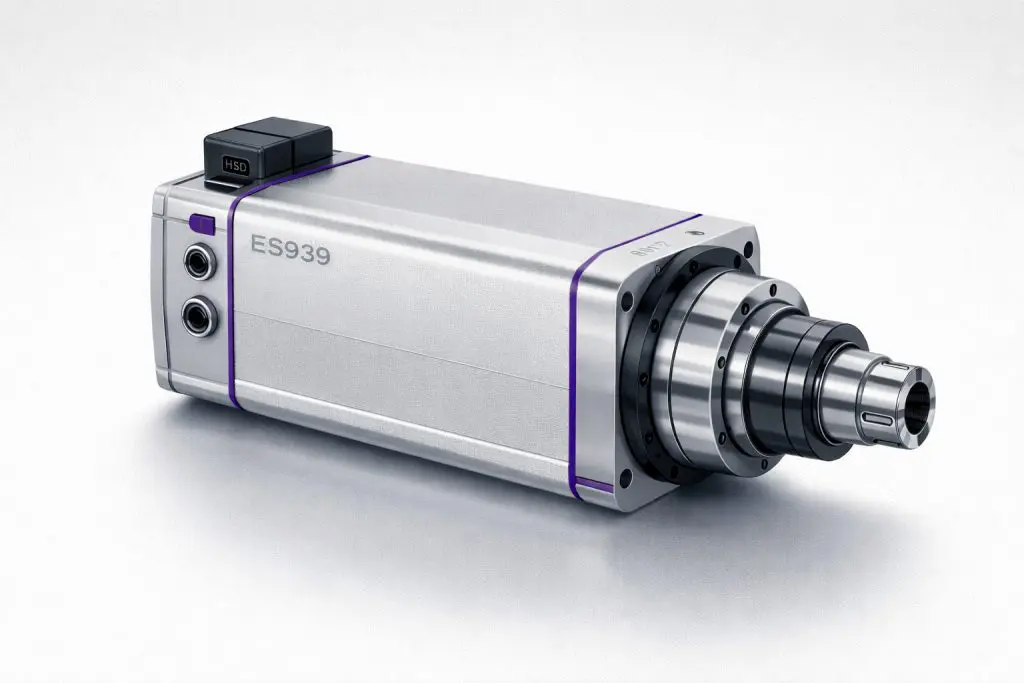
HSD ES939 Spindle Repair: When Vibration Appears Only at Top RPM

HSD ES Series Spindle Repair

HSD ES939 Spindle Repair and Rebuild

The ES939 tends to fail in a specific pattern: smooth at lower and mid-range speeds, then vibration or noise appears near maximum RPM. Operators quietly reduce speed to keep the machine stable — on a spindle designed for high-speed work. That behavior usually points to balance sensitivity caused by internal wear, not tooling. This page covers why it happens, how to confirm the spindle is the source, and how repair decisions are made.

Atlanta Precision Spindles inspects every ES939 before quoting. The rebuild scope is set by what the inspection finds — there is no standard rebuild, because no two spindles arrive in the same condition.

Operating Context

How the HSD ES939 Is Commonly Used

The ES939 typically earns its place in high-speed finishing operations and long production runs — nested-based manufacturing where surface quality matters, and any application that relies on consistent top-end RPM. It spends its working life near its speed limits, and that’s the key to its failure pattern: at maximum RPM, even small internal changes become noticeable, because centrifugal forces amplify whatever imperfection exists.

Why this matters for diagnosis

A spindle that only misbehaves at the top of its range hasn’t developed a “high-RPM problem” — it has developed a balance problem that only high RPM is sensitive enough to reveal. The wear is present at every speed. Maximum RPM is simply where the physics stops hiding it.

Symptom Patterns

Early Symptoms ES939 Operators Notice

Vibration only at high RPM

  • Smooth operation at moderate speeds — nothing seems wrong below the threshold
  • Noise or vibration that increases rapidly as the spindle approaches maximum RPM
  • Finish quality degrading only during high-speed passes — the same part cut slower comes out clean
  • A transition sharp enough that operators can name the RPM where it starts

Operators “working around” the problem

The most common response isn’t a service call — it’s a quiet workaround:

  • RPM pulled back a notch to stay under the vibration threshold
  • Tooling balance assumed to be the root cause, so holders and collets get swapped instead
  • Inspection delayed because production can continue — just not at the speed the spindle was bought for

Not the same failure as a spindle that runs hot

Balance-driven vibration shows up near top RPM whether the spindle is cold or warm, early in the shift or late. If your instability instead builds with heat over the course of a long run — worse late in the shift, better after cooling — that’s a thermal preload pattern, which is a different internal failure. Knowing which pattern you’re seeing is worth establishing before the spindle comes off the machine.

Inside the Spindle

What’s Typically Happening Inside the ES939

Balance sensitivity from bearing wear

A rotating assembly is only as balanced as the bearings that constrain it. As the bearings wear, the shaft’s running precision degrades and internal balance goes with it. The defects involved are tiny — but centrifugal force grows with the square of speed, so an imperfection that is invisible at moderate RPM becomes a measurable vibration near maximum:

Bearings wear → running precision degrades → centrifugal force amplifies small defects → vibration at top RPM

Left unaddressed, this doesn’t stay a top-end problem. The vibration itself accelerates the bearing wear that caused it, and over time the instability spreads down into lower RPM ranges. Bearing degradation is gradual — it accumulates over hundreds of operating hours — which is why the “just run it slower” workaround feels sustainable long after it has stopped being harmless.

Isolation Test

Run the spindle to the vibration onset with three or four different tools and toolholders — including your best-balanced holder with a short, light tool. If the vibration appears at roughly the same RPM regardless of what’s in the taper, the imbalance is in the spindle, not the tooling. A tooling-balance problem follows the tool; a spindle-balance problem stays put when the tool changes.

Also note when it happens: balance-driven vibration is there at top RPM from the first cold pass of the day. If two or more symptoms are present at once — top-end vibration plus new noise plus finish loss spreading to lower speeds — secondary damage is likely already underway, and it’s time to stop working around it.

Symptom lookup: what each observation points to

What you observeWhat it points to
Vibration onset at roughly the same RPM across different tools and holdersSpindle imbalance — the common factor is the rotating assembly, not the tooling
Vibration that follows one specific tool or holderTooling balance — rework or replace that tool or holder before suspecting the spindle
Vibration at top RPM from the first cold pass of the dayBalance-related bearing wear — not heat-dependent, present at every temperature
Instability that builds with heat late in the shift and improves after coolingThermal preload shift — a different internal failure with its own diagnostic path
Vibration onset RPM creeping lower over weeks or monthsProgressive bearing wear spreading down the range — evaluate before it reaches working speeds
New noise appearing alongside the vibration, or finish loss at speeds that used to run cleanTwo or more concurrent symptoms — secondary damage likely underway

Before the Spindle Is Suspected

Why ES939 Problems Get Misdiagnosed

High-RPM vibration has legitimate tooling causes, which is exactly why the spindle gets ruled out last. Here’s where the blame typically lands first — and what distinguishes each from spindle imbalance:

Blamed first: tool balance

An unbalanced tool genuinely does cause high-RPM vibration — this is the most reasonable first suspect. But tool imbalance is specific to the tool. When the vibration onset sits at the same RPM across different tools, the common factor is the spindle they’re all mounted in.

Blamed second: toolholders

A worn or poorly balanced holder is a real vibration source, and holders do age. The same swap logic applies: if your best holder with a short, light tool still hits vibration at the same RPM as the suspect one, the holder isn’t the variable. Replacing holders one after another while the onset RPM never moves is the classic sign the search is in the wrong place.

Blamed third: collets

Collets wear and should be replaced on schedule regardless of appearance — a worn collet adds runout that reads as vibration. But fresh collets that don’t move the vibration onset tell the same story as the tools and holders: the runout is originating behind the taper, in the spindle’s own rotating assembly.

Tooling checks are worth doing — they’re fast, and tooling does cause a share of high-RPM vibration. The misdiagnosis happens when instability repeats across different tools, holders, and collets, and the spindle still isn’t pulled for evaluation.

Repair Options

How ES939 Repair Decisions Are Made

1

Inspection before anything else

Harry inspects every spindle before quoting — this is standard process on every job, not a special step. Teardown findings establish bearing condition, preload state, contamination evidence, and the condition of the shaft and housing seats. Nothing is proposed until the findings are on the bench.

2

High-RPM evaluation and balance testing

For the ES939’s failure pattern specifically, evaluation measures vibration at operating speeds — including the top of the range where the symptom lives — and identifies balance-related wear. This confirms whether the imbalance originates in the spindle’s rotating assembly and whether a rebuild is required, or whether the fault lies elsewhere.

3

Rebuild with precision balancing, scoped to the findings

When imbalance from bearing wear is confirmed, a rebuild restores the rotating assembly’s internal balance — high-RPM vibration is eliminated and finish consistency returns. But replacing bearings alone is not a rebuild: without precision balancing of the assembly and preload set correctly for the operating condition, the new bearings inherit the same instability. Incorrect preload setting is the most common cause of early rebuild failure.

What Running Slower Actually Does

Pulling the RPM back doesn’t stop the wear — it hides it. The spindle gives up the productivity it was chosen for, the progressive bearing damage continues under the quieter operation, and the instability keeps spreading toward lower RPM ranges. By the time the vibration follows you down to the reduced speed, damage that started in the bearings may have progressed into the shaft and housing seats, expanding what the eventual rebuild has to address. High-RPM issues rarely resolve on their own — early correction preserves both the spindle’s performance and its remaining life.

Manufacturer Guidance

HSD-Recommended Maintenance for the ES939

HSD’s official electrospindle documentation for the ES9XX series highlights practices that preserve balance and bearing life:

  • Keep the spindle taper and tool interface clean — debris at the interface adds runout, and runout reads as imbalance at high RPM
  • Monitor spindle behavior across the full RPM range, not just the speeds where daily work happens
  • Ensure proper airflow and cooling so thermal effects don’t stack on top of balance effects
  • Avoid unnecessary lubrication — the bearings are factory-lubricated for life, and adding grease does harm rather than good
  • Perform routine visual and functional checks before extended production runs

These practices align with field experience — balance-related issues worsen quickly when early vibration is ignored. Reference: HSD ES9XX Series Spindle Manual (PDF).

Preventative practices that help ES939 spindles last longer

  • Monitor vibration trends at high RPM — the trend against how the spindle used to run is the earliest warning available
  • Keep tooling interfaces clean so the spindle isn’t carrying added imbalance it didn’t generate
  • Address instability early instead of permanently lowering speed — the workaround gives up the very capability the spindle was chosen for, while the underlying wear keeps progressing

What We Repair — and What We Don’t

Atlanta Precision Spindles repairs and rebuilds the spindle assembly only. We do not service the CNC machine itself — the frame, drives, controls, motion systems, tool changer, or software are outside our scope. Depending on what the job requires, spindle work can extend to the drawbar, clamp system, stator, and actuator. If inspection shows the fault lies outside the spindle assembly, we’ll tell you that directly.

Frequently Asked Questions

HSD ES939 Spindle Repair FAQ

Why does my HSD ES939 vibrate only near maximum RPM?

Because centrifugal force grows with the square of speed, small imbalances that are invisible at moderate RPM become measurable vibration at the top of the range. As bearings wear, the shaft’s running precision degrades and internal balance goes with it. The wear is present at every speed — maximum RPM is simply where the physics stops hiding it.

How do I tell if it’s my tooling or the spindle that’s out of balance?

Run the spindle to the vibration onset with three or four different tools and toolholders, including your best-balanced holder with a short, light tool. A tooling-balance problem follows the tool; a spindle-balance problem stays put. If the vibration appears at roughly the same RPM regardless of what’s in the taper, the imbalance is in the spindle’s rotating assembly.

Can I just run the spindle slower to avoid the vibration?

You can, and many operators do — but it’s a workaround, not a fix. Reducing RPM hides the symptom while the bearing wear that caused it continues to progress, and over time the instability spreads down into lower RPM ranges. Meanwhile the spindle gives up the high-speed capability it was chosen for. High-RPM issues rarely resolve on their own.

Will the vibration spread to lower speeds over time?

Yes, if the underlying wear isn’t addressed. The vibration itself accelerates the bearing wear that caused it, so the instability gradually reaches down into RPM ranges that used to run clean. By the time vibration follows you down to a reduced operating speed, damage that started in the bearings may have progressed into the shaft and housing seats — expanding what the eventual rebuild has to address.

Do ES939 spindle bearings need to be greased or lubricated?

No. Per HSD’s ES9XX series documentation, the bearings are factory-lubricated for life, and the manufacturer specifically advises against adding lubrication. If the bearing system has degraded to the point of causing balance-related vibration, the answer is evaluation and rebuild — not lubrication.

What happens when I send my ES939 in for evaluation?

Harry inspects every spindle before quoting — that’s standard process on every job. For the ES939’s failure pattern, evaluation measures vibration at operating speeds including the top of the range, and teardown findings establish bearing condition, preload state, contamination evidence, and the condition of the shaft and housing seats. The rebuild scope is set by those findings; there is no standard rebuild package.

Do you repair the CNC machine itself?

No. Atlanta Precision Spindles repairs and rebuilds the spindle assembly only — not the CNC machine’s frame, drives, controls, motion systems, tool changer, or software. Depending on the job, spindle work can extend to the drawbar, clamp system, stator, and actuator. If inspection shows the fault lies outside the spindle assembly, we’ll tell you that directly.

Running Your ES939 Slower Than It Was Built For?

If your ES939 runs smoothly at lower speeds but vibrates at the top end, an early evaluation can determine whether internal balance is beginning to degrade. Harry inspects every spindle before quoting, and the findings drive everything that follows.

Lawrenceville, GA · (678) 225-7855 · Serving the US, Canada, and Mexico

Related: HSD ES Series Spindle Repair · HSD ES929: When Aluminum Cutting Starts Causing Chatter · HSD Spindle Bearing Guide · HSD ES915: When Heat and High RPM Start Affecting Performance